Rue Montorgueil Food Street Guide: Bakeries, Cheese And Oysters
Rue Montorgueil is one of the few central Paris streets where the food shops are the whole point: a pedestrian market street of bakers, cheesemongers and seafood stalls, open daily, steps from Les Halles.
Short answer
Rue Montorgueil is a pedestrian market street of permanent food shops between Les Halles and Saint-Eustache, open daily unlike the city's weekly stall markets. Its anchor is Stohrer, the historic bakery, where a Baba au rhum costs 6.10 EUR. No tour on our roster meets here; the closest guided options are the market-style walks departing from Bastille, Île de la Cité and named local markets.
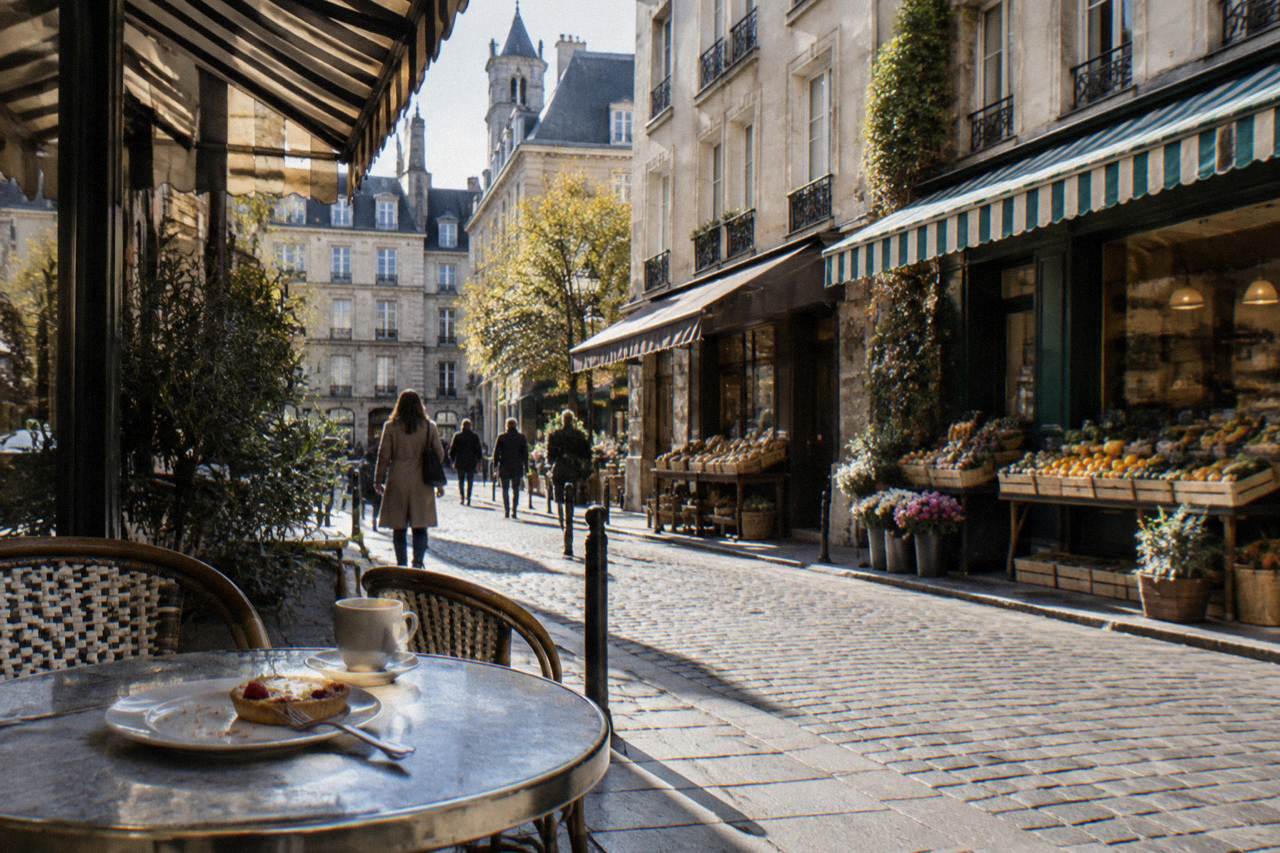
Rue Montorgueil behaves differently from almost every other food address in central Paris. It is a pedestrian market street of permanent shops, bakeries and cheesemongers trading side by side, not a weekly stall market that assembles at dawn and vanishes by two in the afternoon. That distinction shapes everything about a visit: the shops open daily, the rhythm is retail rather than market-day, and the street reads as a single long grocery run rather than a one-morning event.
The street runs from the Saint-Eustache side of Les Halles down toward Réaumur-Sébastopol, anchored by the oldest named pastry institution on the block, Stohrer, where an individual Baba au rhum is 6.10 EUR and the Baba Chantilly version 7.20 EUR. For comparison shopping, our Paris Food Tours pages break down the guided side of the city's food scene, and this guide covers the street you can walk entirely on your own two feet.
What Kind Of Food Street Is Rue Montorgueil?
Rue Montorgueil is a pedestrian street of permanent food shops, open daily, not a scheduled market with stall hours. Paris runs 83 food markets, 74 open-air and 9 covered, nearly all of them closed on Mondays, but streets like this one sidestep that calendar because the shops are simply retail. For a browser, that means Sunday and Monday, the two days when most Paris markets are shut or reduced, are workable here. It also means no arriving early for the best produce, since a cheesemonger's counter at eleven looks much as it did at nine.
The distinction matters because visitors routinely plan around the wrong assumption. They set an alarm for a market that does not exist on that day, then find the stalls packed away. On Rue Montorgueil the failure mode is different and more forgiving: the shops keep regular retail hours, the street is fully pedestrianized, and the whole length can be walked at grocery pace in well under an hour if you do not stop, or stretched into a full morning if you do.
What you get for that convenience is depth rather than abundance. A weekly market stacks fifty producers in rows for four hours; a market street spreads a comparable range across bakers, fromagers, fishmongers, wine shops and cafés that are there every day of the week. The browsing style changes accordingly. You are not racing a closing bell. You are moving shop to shop, buying a little at each, and the locals you see are doing exactly the same thing with a basket rather than a camera.
The other practical payoff is the pedestrianization itself. There are tables on the street, terraces in good weather, and room to stand at a window counter without a car behind you. Very few central Paris food concentrations offer that combination of car-free space and daily opening, which is a fair part of why the street draws the crowd it does (see Daily Food Budget).
Where To Start And What To Buy: Bakeries, Cheese, Oysters
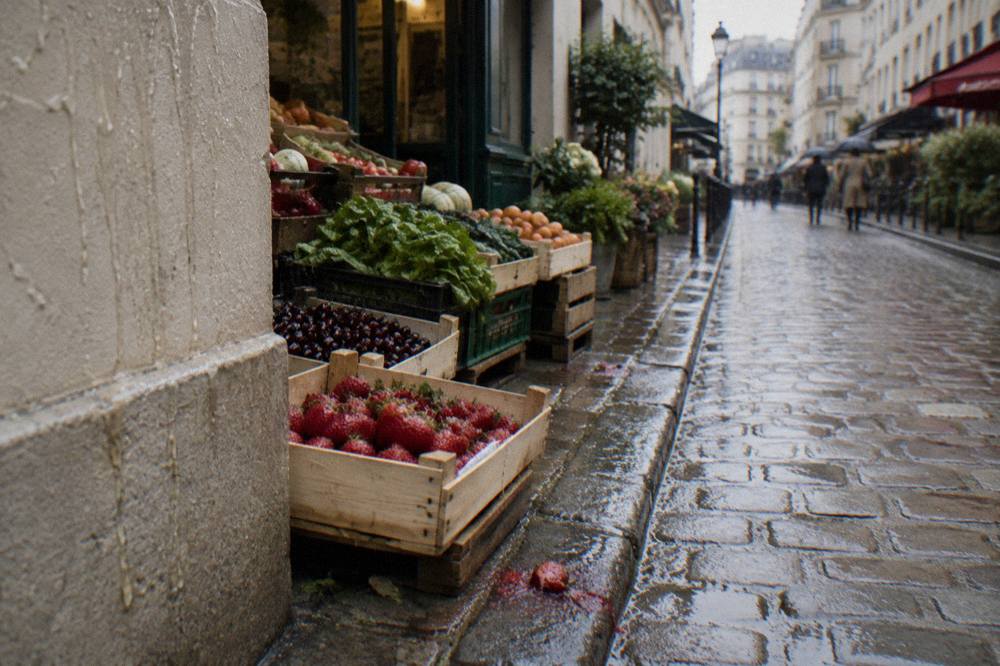
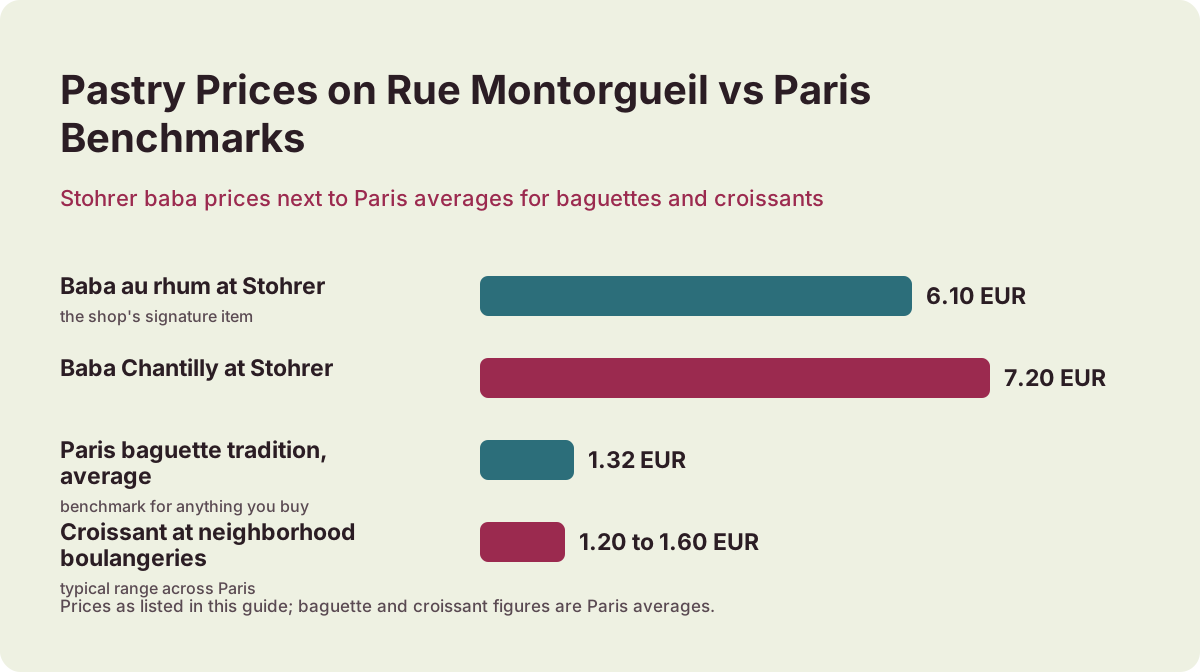
Start at the Les Halles end near Saint-Eustache and walk the street downhill: the historic bakery Stohrer sits on this street and anchors the pastry stops, cheese counters and seafood displays line the middle stretches, and an average Paris baguette tradition runs 1.32 EUR for benchmarking anything you buy. Croissants at neighborhood boulangeries in Paris run roughly 1.20 to 1.60 EUR, so a pastry priced far above that band should come with a reason you can taste.
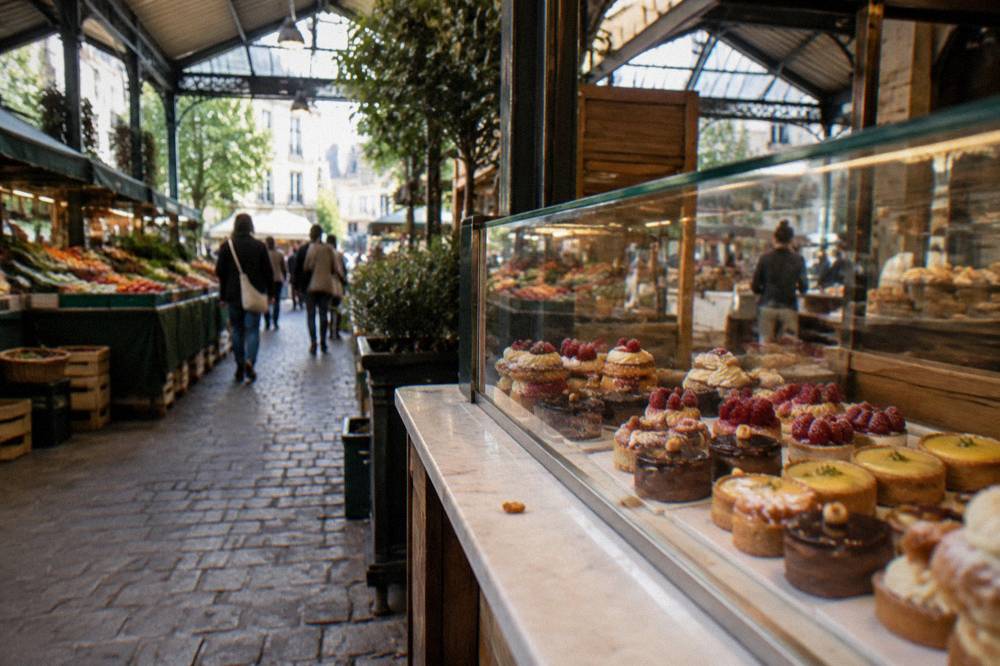
On pastry, the one named institution the verified record supports is Stohrer, the bakery whose individual Baba au rhum is listed at 6.10 EUR and whose Baba Chantilly runs 7.20 EUR. The baba is the shop's signature, a yeast cake soaked in rum syrup, and it is the single most food-historically loaded sweet on the street. Everything beyond that, work the counters rather than a checklist: the street's character is in the window displays, and the reliable play is one pastry, one cheese stop, one seafood stop, in whatever order the crowds let you.
The cheese angle deserves a slow pass. Paris fromagers on a market street like this typically carry dozens of French AOP and IGP dairy products, and France counts 51 AOP and 12 IGP dairy items in the official 2024 figures. A counter staffed by a fromager will cut to order, which is the difference between a market street and a supermarket aisle. Tell them when you plan to eat it; that single sentence changes what they hand you.
Oysters and seafood complete the classic trio of the street's identity. Displays of fresh oysters are a standard sight on central Paris market streets, and the pattern is simple: bought by the half dozen, opened on the spot or packed for later, eaten nearby or carried home. Pair the stop with a bottle from a wine shop on the same street and you have assembled the standard Parisian market-street lunch without a restaurant in sight.
The baguette itself is worth a sentence of respect. The know-how and culture of the baguette was inscribed by UNESCO in 2022, and the city crowns an annual best-baguette winner, in 2026 a baker in the 14th arrondissement who beat 142 other entries for a 4,000 EUR prize, per the city's own announcement on paris.fr. None of that guarantees a transcendent loaf on this street, but it explains why Parisians still queue for bread worth 1.32 EUR on average.
If pastry is your main interest rather than one stop among several, a dedicated walk changes the math. The Pastry and Chocolate Walk, a two-and-a-half-hour small-group tour through the covered passages near Grands Boulevards, runs 6+ tastings from $90 per person with a 5 rating from 368 reviews, and it starts from the passage network a short walk from this street's northern end.
If browsing a market street on your own is the plan but you want the guided version of the same instinct, these are the three market-style tours on our roster that come closest to the Rue Montorgueil experience.
When To Go: Daily Shops, Weekly Markets, And Timing
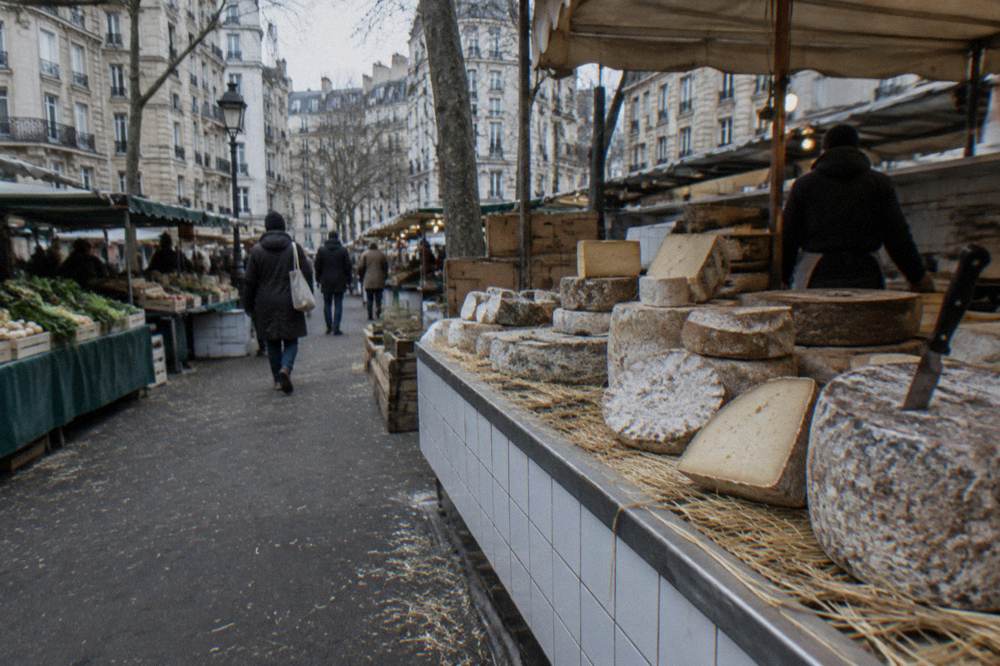
Go any day including Sunday and Monday, because the shops on this street are permanent retail; the city's actual food markets, all 83 of them, close on Mondays, and morning stall markets finish by 13h30 on weekdays and 14h30 at weekends. The timing decision on Rue Montorgueil is therefore about crowd comfort, not opening calendars: mid-morning on a weekday is the calm version, weekend afternoons are the busy, atmospheric version.
For contrast, here is how the street sits against the city's scheduled markets, using the official hours the city publishes for the covered halls:
| Food destination | Type | Open | Hours as published |
|---|---|---|---|
| Rue Montorgueil | Pedestrian street of permanent shops | Daily | Individual shop hours; no market schedule |
| Marché d'Aligre (open-air) | Stall market | Tue to Sun | 7h30 to 13h30, later on weekends |
| Marché couvert Beauvau | Covered hall | Tue to Sun | Tue-Fri 8h-13h and 16h-19h30; Sat 8h-19h30; Sun 8h-13h30 |
| Marché des Enfants Rouges | Covered hall | Tue to Sun | Tue, Wed, Fri, Sat 8h30-20h30; Thu to 21h30; Sun 8h30-17h |
| Marché Bastille | Stall market | Thu and Sun only | 7h to 13h30, to 14h30 on Sunday |
| Marché Raspail bio | Organic stall market | Sun (organic); Tue and Fri (regular) | 7h to 14h30 Sun; 7h to 13h30 Tue and Fri |
The Monday column is the quiet trap in Paris food planning. Every listed food market in the city closes on Mondays, per the official paris.fr market pages, so a Monday visitor who wants market energy has essentially two choices: a permanent-shop street like this one, or a covered hall that happens to run a Tuesday schedule. Getting this wrong is the single most common reason a planned market morning evaporates.
Lunch timing matters if you plan to eat on or near the street. Typical Paris lunch service runs noon to about 14h30 with kitchens closing after, and dinner service starts between 19h00 and 19h30. A late 15h arrival finds kitchens between services, which is fine for retail browsing and window counters, less good for a sit-down meal. By law, menus and plats du jour must be displayed outside from at least 11h30 for lunch and 18h00 for dinner, so you can read your options before committing.
Seasonality is the subtler timing layer. Autumn markets carry squash from October plus apples, pears, figs and plums; winter brings citrus from December, leeks, endive and parsnip; spring means peas, asparagus, artichoke, rhubarb and strawberries; summer is melon, raspberry, courgette, aubergine and pepper. A market street reflects the same calendar in its windows, so what you see in the displays is a fair index of what is actually good.
No Food Tour Meets On Rue Montorgueil, So What Comes Closest?
No tour on our 28-listing roster meets on Rue Montorgueil, and we will not pretend otherwise: the closest matches are market-style guided walks departing from a named local market, from Île de la Cité, and from Bastille, all of which deliver the same guided-shopping-and-tasting instinct this street rewards. If a guided version of your visit matters, the honest move is to pick the tour by its market and meeting point, then walk Rue Montorgueil yourself on a separate morning.
The closest match in spirit is the Market Stroll, Picnic walk by With Love From Paris Tours, a 2 to 3 hour small-group stroll through a local Parisian market, with the meeting point sent on booking, from $172 per person and a 5 rating from 24 reviews. It includes a picnic built from the market's own cheese, bread and other stalls, a glass of wine or champagne, and small surprises, with an indoor fallback when weather kills the picnic plan. Free cancellation runs up to 24 hours before the start.
The History Walk, Market Meal tour by Le Paris de Sophie takes a different cut: it starts at Île de la Cité by Pont au Change, walks 2 to 3 hours through historic Paris toward a vibrant food market, and includes lunch, from $217 per person with a 5 rating from 73 reviews, groups capped at 8. It suits the visitor who wants the market woven into the city's history rather than treated as a shopping exercise.
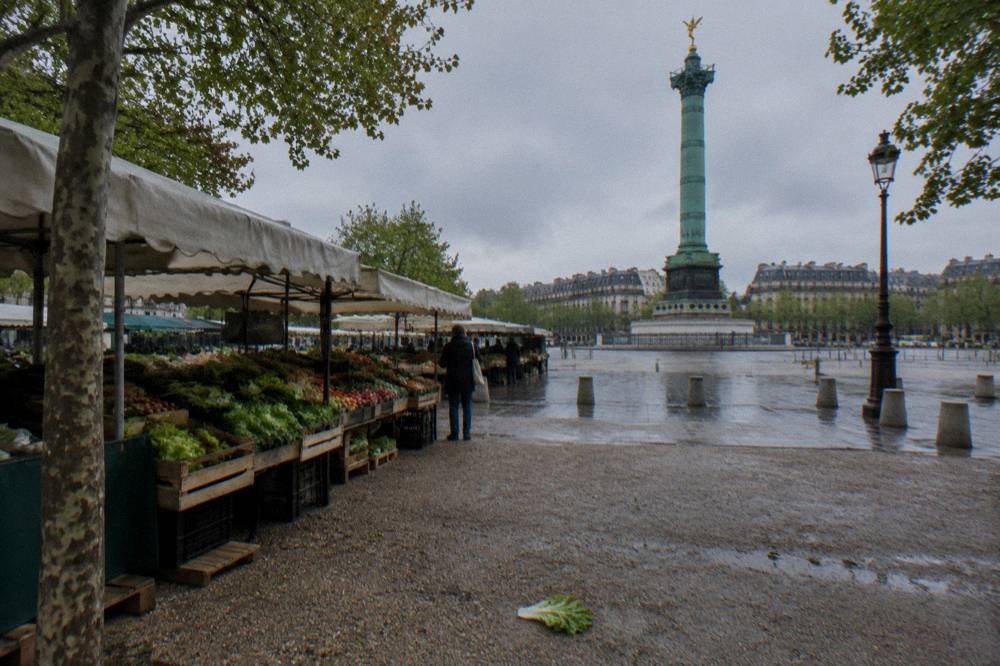
The budget end is the Aligre Market, 2 Hours walk by Original Food Tours from the Bastille side, from $126 per person, 4.4 from 24 reviews, ten guests max, wine and food tastings through one of the city's most lived-in markets. And if your interest in this street is really the pastry counter, the Pastry and Chocolate Walk from the Grands Boulevards passages, from $90 per person, is the guided expression of that.
A comparison table makes the differences concrete:
| Guided option | Operator | Meeting area | Duration | From (per person) | Rating and reviews |
|---|---|---|---|---|---|
| Market Stroll, Picnic | With Love From Paris Tours | Local market, point sent on booking | 2 to 3 hours | $172 | 5 from 24 reviews |
| History Walk, Market Meal | Le Paris de Sophie | Île de la Cité (Pont au Change) | 2 to 3 hours | $217 | 5 from 73 reviews |
| Aligre Market, 2 Hours | Original Food Tours | Bastille / Marché d'Aligre | 2 hours | $126 | 4.4 from 24 reviews |
| Pastry and Chocolate Walk | Devour France Food Tours | Grands Boulevards (covered passages) | 2.5 hours | $90 | 5 from 368 reviews |
For planning the guided side more broadly, our market-tours overview collects every market walk on the roster, and the Paris food markets and market tours guide covers the city's market system in depth, including which halls run which days.
Rue Montorgueil Compared With The Other Famous Food Streets
The honest ranking depends on what you want from the walk: this street is the fully pedestrian, daily-open version; Rue Cler near the Eiffel Tower is the permanent-shop street with monument traffic; and the Marais pairs a 1615 covered hall with a neighborhood of falafel and artisan shops around it. None of the three is a stall market, which is why all three work on days the true markets do not.
Rue Cler functions the same way structurally, a permanent food-shops street rather than a stall market, open daily, positioned near the Eiffel Tower for visitors building a sightseeing day around groceries. Its trade-off is location-driven crowds: the browsing is pleasant, the context is monument Paris rather than market-district Paris. It suits a visitor already committed to the 7th arrondissement for the morning.
The Marais option is the richest of the three for a long food day. Marché des Enfants Rouges, founded in 1615 and the oldest covered market in the city, runs Tue to Sat 8h30 to 20h30, Thursday to 21h30, and Sun 8h30 to 17h, closed Monday, with world-cuisine stalls that take no reservations and peak at lunch between 12h and 14h30. Around it sits the Rue des Rosiers cluster, where L'As du Fallafel at 34 Rue des Rosiers sells its falafel sandwich for 10 EUR and closes on Saturdays. Our Le Marais food tour guide covers that district in full.
The comparison in one view:
| Street or market | Best for | Open Monday | Character |
|---|---|---|---|
| Rue Montorgueil | Daily browsing, pastry history, oysters and wine | Yes (shops) | Pedestrian, central, permanent retail |
| Rue Cler | Eiffel Tower mornings, classic shopfronts | Yes (shops) | Monument-adjacent, permanent retail |
| Marais / Enfants Rouges | Long food day, world cuisines, falafel | No (hall) | Covered hall plus dense food streets |
| Marché d'Aligre | Lived-in market energy, brocante | No | Open-air plus covered hall, since the 18th century |
| Marché Raspail bio | Certified organic produce, Sundays | No | Around 50 certified stalls, one of four 100% organic markets |
A practical note on combining them: the street pairs naturally with a Les Halles and passage-morning, since the covered passages sit minutes away on foot, while Aligre and Enfants Rouges pair with each other only loosely, separated by a metro ride. Two food destinations per day is a realistic maximum before quality of attention drops.
A Self-Guided Morning Plan And What It Costs
A realistic budget for a self-guided browse runs to roughly 10 to 20 EUR per person for pastry, cheese and a baguette benchmarked against the city averages, plus 10 EUR if you add a falafel-scale hot stop elsewhere, or 21 EUR for a box of six macarons at the top end of the souvenir scale, with guided alternatives from $90 per person. Those figures come from the verified price record, not from any single shop on the street, so treat them as planning ranges and check the counter.
The shape of the morning is simple. Arrive mid-morning on a weekday if you can, start at the Saint-Eustache end, buy one thing at each of three stops rather than everything at the first, and finish either at a terrace table or, in better weather, with the assembly carried to a nearby bench. The failure mode of a market-street walk is front-loading: one shop, one full bag, and then thirty minutes of carrying it past everything you actually wanted.
For the guided versions of the same instinct, the price ladder is short. The Pastry and Chocolate Walk from $90 per person covers the sweet end. The Aligre Market walk from $126 per person covers a real working market. The Market Stroll, Picnic walk from $172 per person adds the assembled picnic and a glass of wine, and the History Walk, Market Meal tour from $217 per person adds a full lunch and the historic-Paris framing. Every one of them meets elsewhere, which is the honest cost of the fact that no roster tour departs from this street.
| Self-guided stop | Typical planning range | Notes |
|---|---|---|
| Croissant or pastry | 1.20 to 1.60 EUR | Neighborhood boulangerie range in Paris |
| Baguette tradition | 1.32 EUR average | Citywide average, higher in central districts |
| Signature pastry (Baba au rhum) | 6.10 EUR | Stohrer's listed individual price; Chantilly version 7.20 EUR |
| Macarons, souvenir box | 21 EUR for six | Major-house price for the box benchmark |
| Falafel, hot stop (Marais) | 10 EUR | L'As du Fallafel takeaway price, closed Saturdays |
Dietary notes belong in the planning, not the hoping. Vegetarian visitors are well served by cheese, bread and pastry by default, but allergies and gluten or dairy restrictions should be raised with each counter directly, and the same applies to any guided tour: confirm with the operator before booking rather than assuming. The Stohrer baba, for instance, is a rum-soaked cake, which matters for both alcohol and gluten questions.
Common Questions About Rue Montorgueil
Is Rue Montorgueil open on Sundays and Mondays?
Yes. It is a pedestrian street of permanent shops rather than a scheduled market, so the shops keep daily retail hours. That makes it one of the few central food destinations that works on Monday, the day every listed food market in Paris closes, and on Sunday, when the weekly markets run only until about 14h30.
Is Rue Montorgueil a market or a shopping street?
A shopping street. The city classifies its 83 food markets as scheduled stall markets or covered halls with published hours; Rue Montorgueil instead is a pedestrian street of permanent food shops, bakeries, cheesemongers and fishmongers, open daily. The browsing style is shop-to-shop retail rather than market-day foraging.
What is the most famous food stop on Rue Montorgueil?
The historic bakery Stohrer, whose individual Baba au rhum is listed at 6.10 EUR and whose Baba Chantilly runs 7.20 EUR. The baba, a rum-soaked yeast cake, is the signature sweet of the house. Beyond that, the street's identity rests on its cheese counters and fresh oyster displays rather than on any single named address.
Do any food tours meet on Rue Montorgueil?
No tour on our roster of 28 verified listings meets there, and we say so plainly rather than stretching a meeting point. The closest guided equivalents are the market-style walks: the Market Stroll, Picnic tour from $172 per person, the History Walk with market meal from $217 per person, and the two-hour Aligre market walk from $126 per person.
How much time should I spend on Rue Montorgueil?
Allow one to two hours for a genuine browse with purchases at three or four stops, longer if you sit at a terrace. The street itself is short and fully pedestrian, so the time goes into the counters, not the walking. Pair it with the covered passages near Grands Boulevards for a half-day central food walk.
How does Rue Montorgueil compare with Rue Cler or the Enfants Rouges market?
This street is the fully pedestrian, daily-open central option. Rue Cler is the same permanent-shop format near the Eiffel Tower with monument crowds. The Marais instead offers the 1615 covered hall Enfants Rouges, open Tue to Sun with world-cuisine stalls, closed Monday, surrounded by falafel addresses like L'As du Fallafel at 10 EUR a sandwich. All three beat the stall markets on Monday availability, but only the first two are streets rather than scheduled halls.
If you have walked the street and want the guided version of the same instinct next time, these are the three market walks closest in spirit.