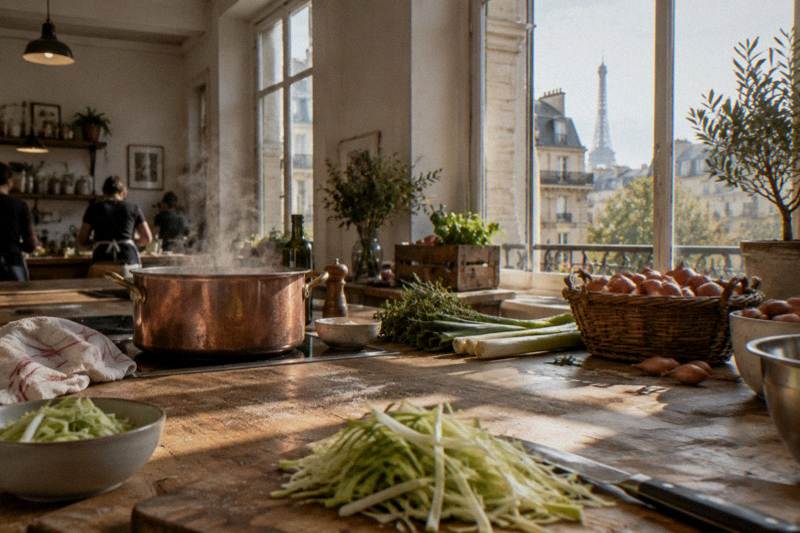
Cooking Classes In Paris: Market, Bistro And Full-Day Options
A hands-on class is the food experience that outlasts the trip: you carry the recipe home. Here is how the bookable Paris options compare on duration, group size, price and what you actually eat.
Short answer
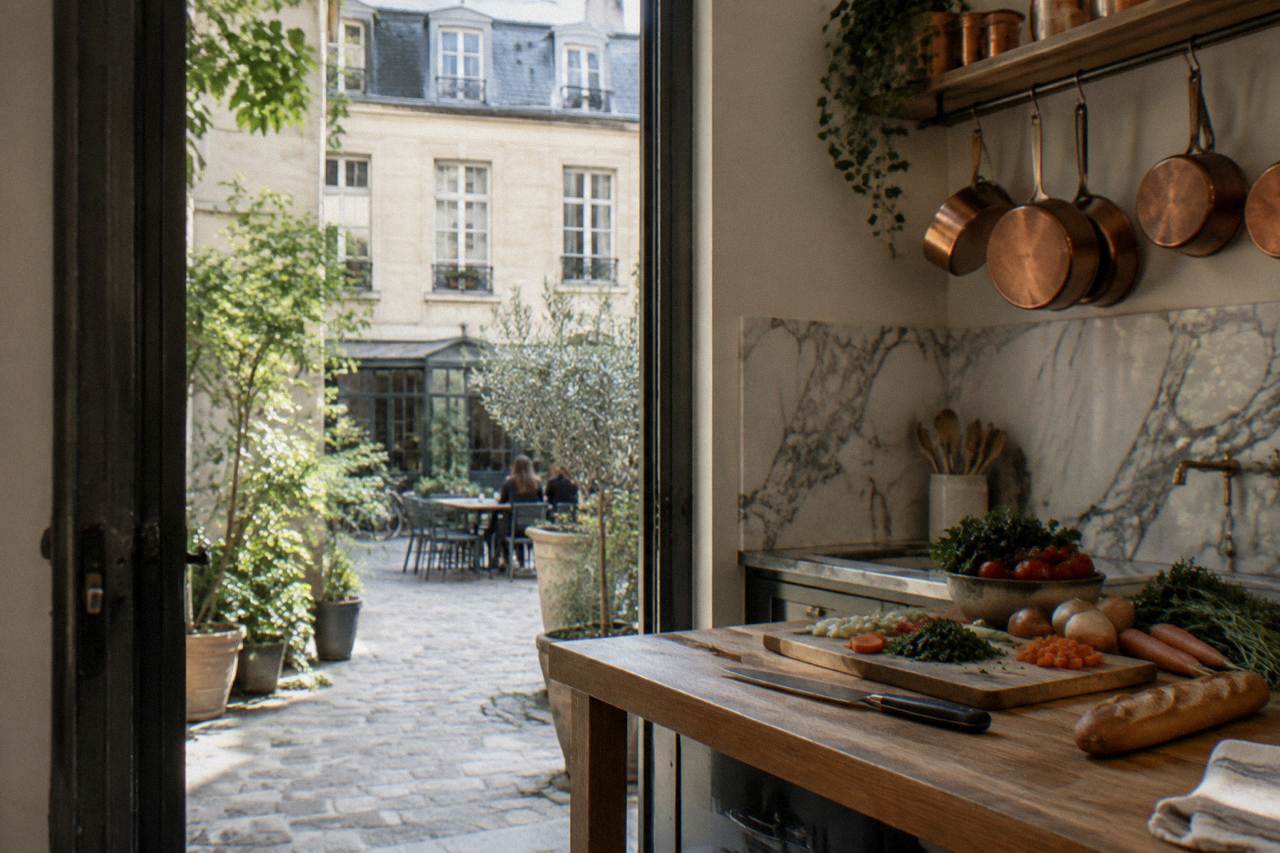
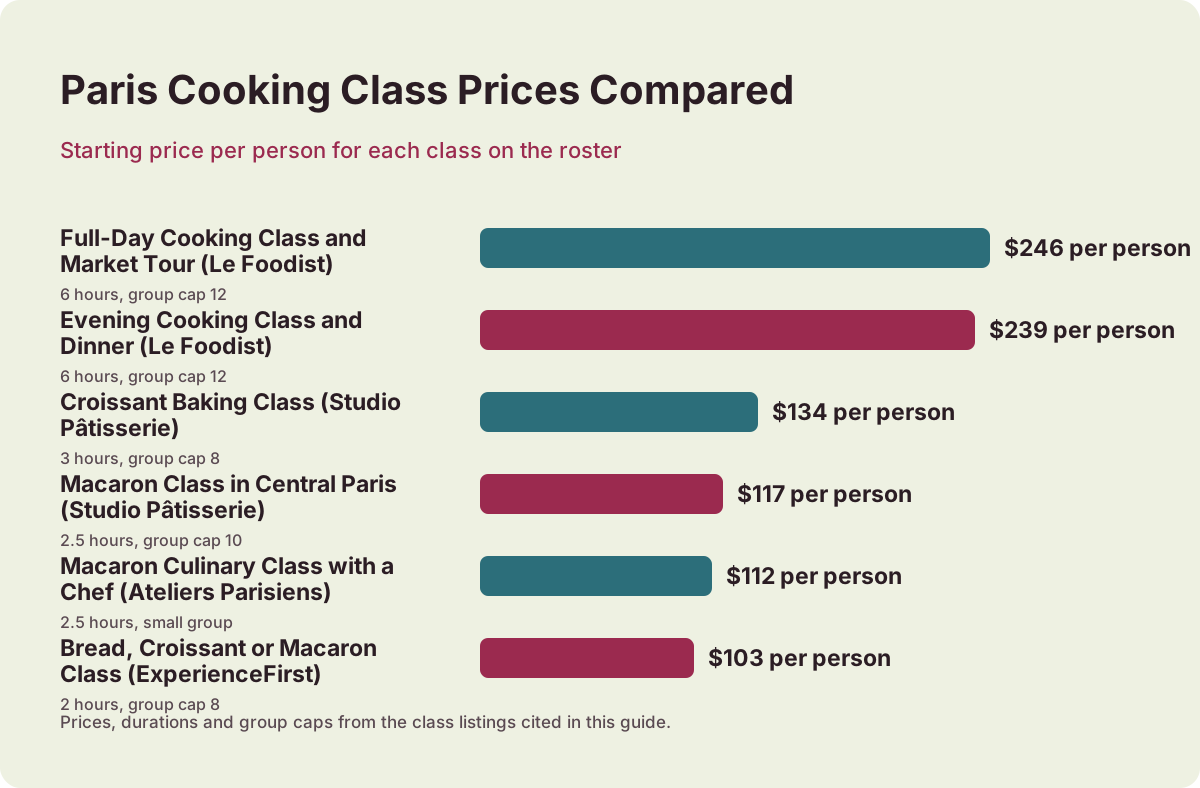
Paris cooking classes split into three formats: full-day market and cooking experiences (about 6 hours, from $246), evening classes ending in a cooked dinner (6 hours, from $239), and shorter baking classes for croissants, macarons or bread (2 to 3 hours, from $103). Most cap groups at 8 to 12 people and none includes hotel pickup.
A cooking class in Paris is the one food purchase that keeps paying after the flight home: the recipe, the knife hold, the way you fold a croissant. This guide compares every cooking and baking class on this site's roster, six options in total, on duration, group size, price and what you actually eat, using only the figures printed on the verified listings. It also flags the one class with a different cancellation policy, because that detail matters when plans shift.
The roster covers two French cooking classes with meals (a full-day class with a market tour, and an evening class with dinner) and four baking-focused classes: a chef-led macaron class, a croissant class capped at eight, a central-Paris macaron class, and a flexible bread, croissant or macaron option. That spread means the real decision is not whether to take a cooking class in Paris but which shape of one fits your trip: a six-hour commitment with wine at the end, or a two-hour pastry session that leaves the afternoon free. To see how every option stacks up before you book, the guide to Paris cooking class durations explains what each length actually covers and how to match it to the rest of your day.
What Types Of Cooking Class Can You Book In Paris?
Paris classes come in three practical formats: a full-day market visit plus cooking class with a four-course lunch (about 6 hours, from $246 per person), an evening class that finishes with the three-course dinner you cooked (6 hours, from $239), and short hands-on baking classes for croissants, macarons or baguettes running 2 to 3 hours and starting from $103. All are small-group, none exceeds 12 participants, and none offers hotel pickup.
The full-day and evening classes are savoury cooking experiences: you shop, chop, cook and then sit down to eat what the group made, with wine. The baking classes are narrower and faster. A macaron class teaches shells and fillings; a croissant class teaches lamination, the folding that creates the layers. Both send you home with a box of what you made. If your goal is a recipe you will reuse for guests, the full-day class prints hard-copy and electronic recipes in English for every participant, a detail the listing spells out explicitly.
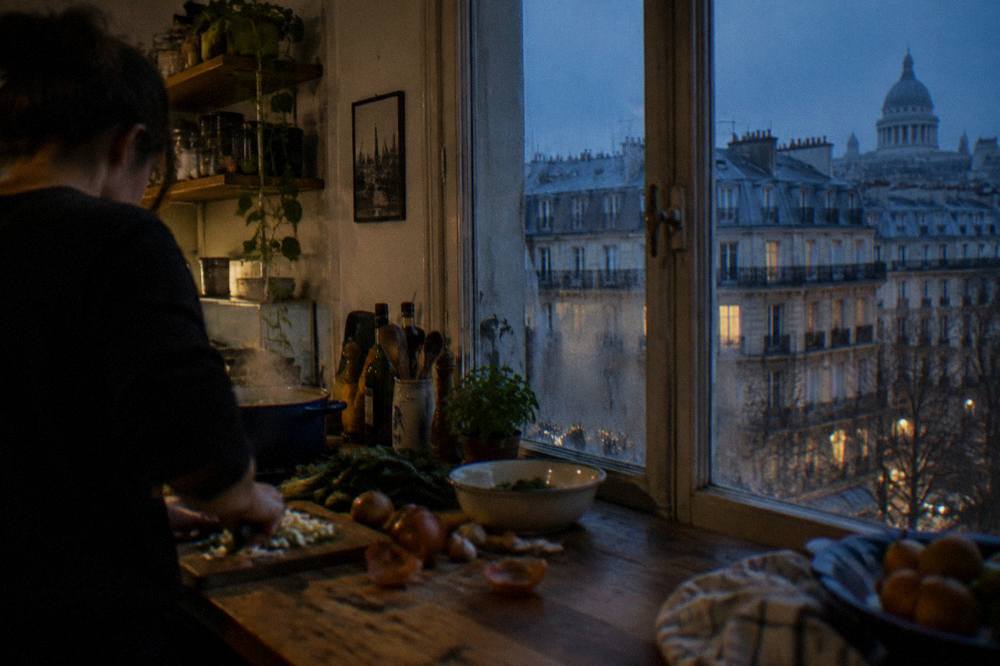
Where the formats genuinely differ is energy and scheduling. A six-hour class eats most of a day, so it suits a trip with a slow morning or a planned evening elsewhere. The baking classes slot into a morning or late afternoon without dismantling the rest of the plan. Travellers trying to decide between a class and a walk can weigh the trade-offs in is a cooking class in Paris worth it, which works through the value question with the same roster numbers.
One boundary worth stating plainly: children's policies vary by listing and only the listings' own wording counts. The Le Foodist full-day class does not permit children under 12; the evening class sets a minimum age of 12; the bread, croissant or macaron class by ExperienceFirst allows children accompanied by an adult, with kids under 5 joining free of charge but not participating. Families will find more options laid out in the family cooking classes in Paris guide.
| Class | Operator | Duration | Price from | Group cap |
|---|---|---|---|---|
| Full-Day Cooking Class, Market Tour and Lunch | Le Foodist | 6 hours | $246 per person | 12 |
| Evening Cooking Class, French Dinner and Market Visit Option | Le Foodist | 6 hours | $239 per person | 12 |
| French Macaron Culinary Class with a Chef | Ateliers Parisiens | 2.5 hours | $112 per person | small group |
| Croissant Baking Class with a Chef | Studio Pâtisserie | 3 hours | $134 per person | 8 |
| Macaron Baking Class in Central Paris | Studio Pâtisserie | 2.5 hours | $117 per person | 10 |
| French Baking Experience: Bread, Croissant or Macaron Class | ExperienceFirst | 2 hours | $103 per person | 8 |
What Does The Full-Day Market And Cooking Class Include?
The full-day class by Le Foodist, from $246 per person, runs about 6 hours in the Latin Quarter and combines a guided market visit with a hands-on cooking session capped at 12 people. It ends in a four-course meal with cheeses and both red and white wines, and every participant leaves with hard-copy and electronic recipes in English. Free cancellation applies up to 24 hours before the start.
This is the class for travellers who want the whole arc: choosing the produce, cooking it, then eating it properly. The listing lists the inclusions precisely: a market tour, use of all cooking equipment and an apron, the four-course meal with wines, and the recipe pack. Reviews support the format strongly: the class holds a 4.9 rating from 142 reviews. A guest review on the evening sibling class captures the Le Foodist teaching style, calling the chef "amazing" and the food "absolutely delicious," which reflects on the same school's kitchen culture.
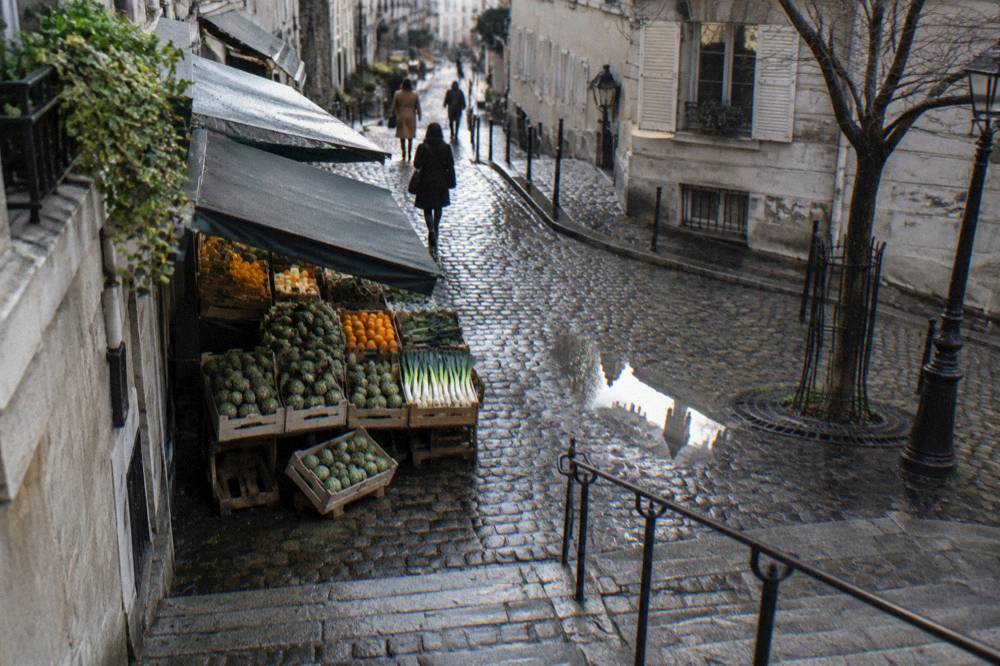
The market leg is not decoration. Paris runs 83 food markets, 74 open-air and 9 covered, and they are closed on Mondays, so a Monday booking changes what the market visit looks like; the city's own market pages state the Monday closure plainly (paris.fr market listings). Morning markets open at 7h and run to 13h30 on weekdays, which is exactly the window a full-day class with a market component uses.
You can compare the format with walking alternatives in the Paris food markets and market tours guide; the difference is that here the market is the first act of a meal you cook yourself, not the whole show. If a six-hour commitment feels heavy, the same operator's evening class covers similar ground after dark, and the next section covers it.
How Does The Evening Cooking Class Compare?
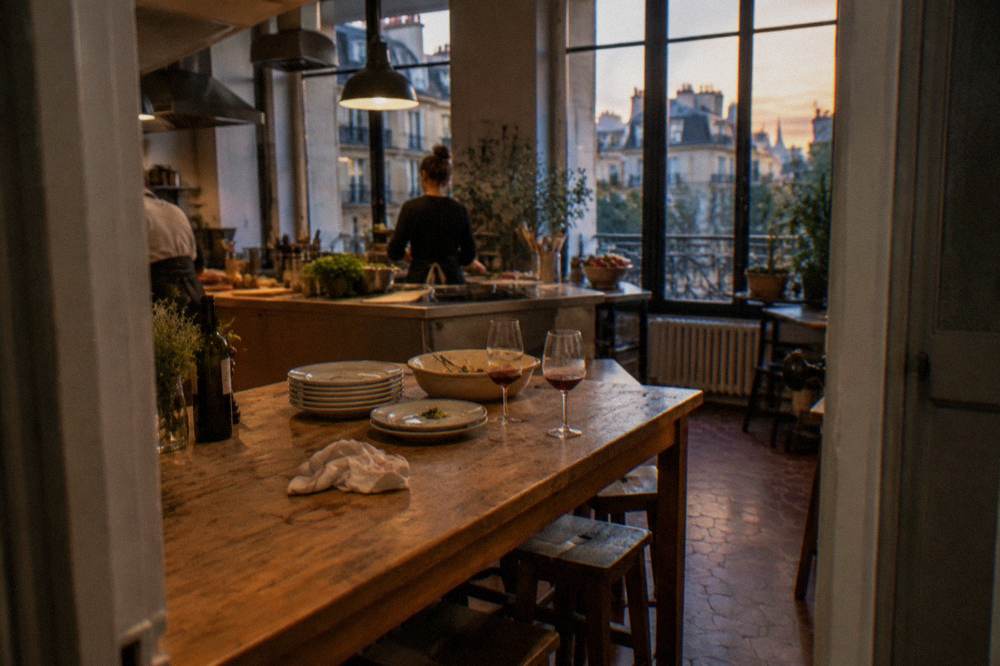
The evening class by Le Foodist, from $239 per person, runs 6 hours from Saint-Germain-des-Prés (Mabillon) and can include a market visit, finishing with a three-course dinner the group cooked, with drinks. The key difference from every other class on the roster is cancellation: this listing requires cancellation 6 full days before the start for a full refund, with a 50% refund 2 to 6 days before.
That cancellation window is the single most decision-relevant fine print on this page. Every other roster class prints the standard free cancellation up to 24 hours before the start. The evening class does not: book it only when your evening is genuinely settled. It holds a 4.9 rating from 500 reviews, and the verbatim guest quotes reinforce the format, one calling it "the highlight of our stay in Paris," another "one of our best meals in Paris."
The evening class suits travellers whose days are full of sightseeing and who want the food experience to be the evening itself. You walk in, cook, and eat dinner at the end of it, so the class replaces a restaurant booking rather than competing with one. Minimum age is 12, and unaccompanied children are not accepted, per the listing's own notes.
Between the full-day and evening formats, the honest question is what you want the class to replace: a lunch (full-day) or a dinner (evening). Both run 6 hours, both cap at 12, both are taught in English, and both cost within $7 of each other. The full-day class includes the recipe pack and a four-course meal; the evening class centres on the three-course dinner. Price-sensitive readers can see the full budget picture in how much does a food tour in Paris cost.
Which Baking Class Should You Choose: Croissant, Macaron Or Bread?
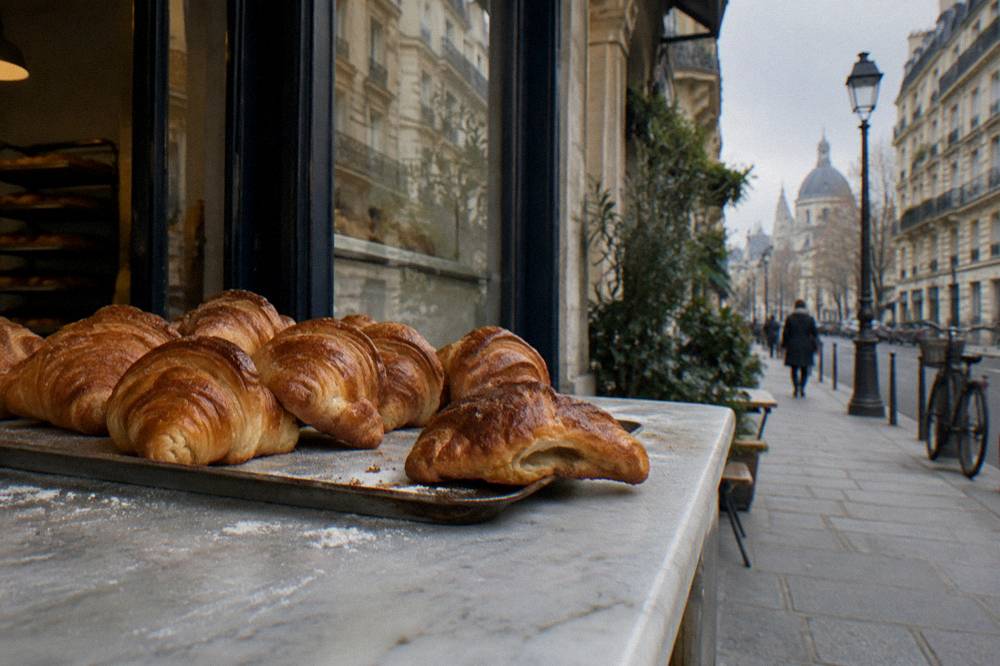
The roster's four baking classes run 2 to 3 hours and start from $103. The ExperienceFirst bread, croissant or macaron class (from $103, max 8) is the flexible pick; Studio Pâtisserie's croissant class (from $134, max 8, 3 hours) is the deepest croissant training; the two macaron classes (from $112 and $117) focus on shells and fillings. All end with tastings or a box to take away, and none serves alcohol.
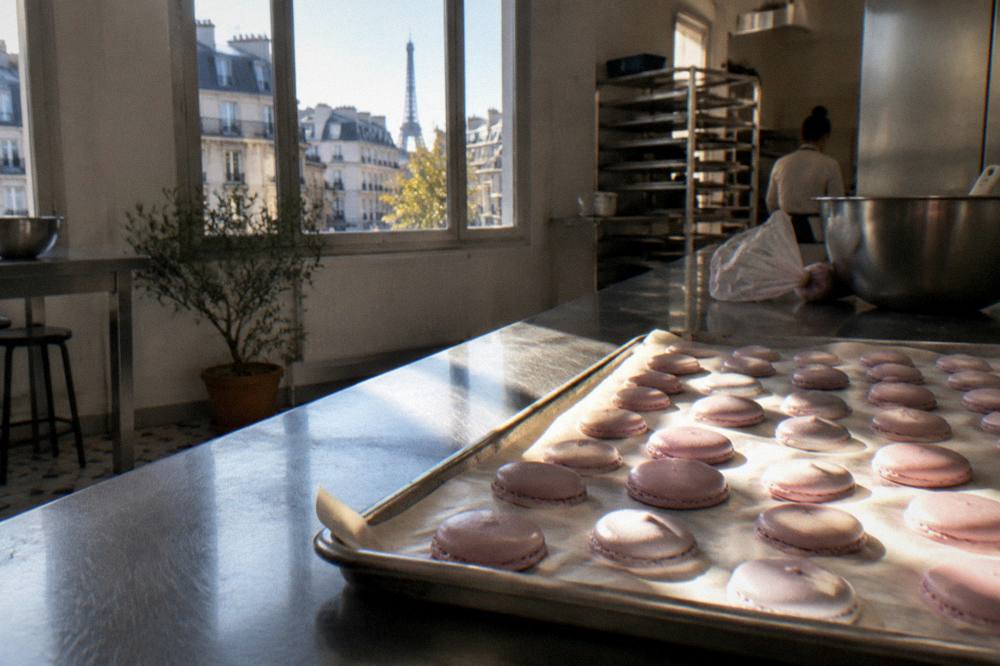
Baking classes trade the meal for a skill. The croissant class by Studio Pâtisserie, capped at 8 and rated 5 from 243 reviews, covers lamination and shaping with professional-grade kitchen equipment, and children under 17 must come with a paying adult. The macaron classes are shorter at 2.5 hours: Ateliers Parisiens' chef-led version (4.9 from 715 reviews, from $112) sends you home with a box of macarons, and the central-Paris Studio Pâtisserie version (5 from 278 reviews, from $117) includes a recipe to take home. More detail on each appears in the dedicated macaron class in Paris and croissant making class in Paris guides.
The ExperienceFirst class deserves a specific mention for families: it allows children with an adult, kids under 5 join free of charge without participating, and a guest review describes learning baguettes, croissants and small cakes with a baker and leaving with what you baked. It is the only roster baking class that lets a five-year-old be in the room at no charge.
Why croissants justify a class at all: the artisanal know-how behind the baguette is UNESCO-listed heritage, inscribed in 2022 as artisanal know-how and culture (UNESCO intangible heritage listing). Lamination is the hard part, the repeated folding of butter into dough that a three-hour class can actually teach you to feel with your hands, which no video does.
The wider class scene beyond this roster confirms the price band: a survey of school pages shows a 3-hour technical macaron class at €129 and a market-and-cooking morning at €199 at one well-known school, and Le Cordon Bleu short workshops from €270 (Le Cordon Bleu Paris workshops). The roster's classes sit at or below those marks, which is useful context, not a claim about quality.
What Do You Actually Cook, Bake And Take Home?
The two Le Foodist classes end in full cooked meals: a four-course lunch with cheeses and red and white wines on the full-day class, a three-course dinner on the evening class. The baking classes end in product instead: a box of macarons from the Ateliers Parisiens class, your own croissants from the Studio Pâtisserie class, a recipe plus tasting from the central macaron class, and tastings or take-home creations from the ExperienceFirst class.
The distinction matters more than it first appears. A meal class is a social experience built around a table: you cook alongside up to 11 other people and then eat with them, which is why the shared-dinner format draws the most effusive guest reviews on the roster. A baking class is closer to a workshop: the payoff is the skill and the box, and the eating happens on the walk home or back at the hotel. Travellers who book a baking class expecting a meal consistently get less food than they imagined, so calibrate before you pay.
| Class | What you make | What you eat or take away | Drinks included |
|---|---|---|---|
| Full-Day Class and Lunch | Four courses from market produce | Four-course meal with cheeses | Red and white wines |
| Evening Class and Dinner | Three-course French dinner | The dinner you cooked | Yes, drinks listed |
| Macaron Class with a Chef | Macaron shells and fillings | Box of macarons | No |
| Croissant Baking Class | Laminated croissant dough | Your own croissants | No |
| Central Paris Macaron Class | Macarons in a central kitchen | Tasting plus recipe to take home | No |
| Bread, Croissant or Macaron | Baguettes, croissants or macarons | Tastings of your creations or take away | No |
Note the drinks column: only the two cooking classes include alcohol, and the legal drinking age in France is 18 for all alcohol, with sale or free offer to under-18s prohibited, so younger participants on the savoury classes will be pouring something else. The baking classes serve no alcohol at all, which also makes them the safer booking for teetotallers and for anyone who simply prefers a morning session without wine.
How Do Durations And Group Sizes Stack Up?
Group sizes range from 8 to 12 across the roster, with the croissant, central macaron and ExperienceFirst classes most intimate at 8 to 10, and both Le Foodist cooking classes at 12. Durations split cleanly: 6 hours for the two cooking-with-meal classes, 3 hours for croissants, and 2 to 2.5 hours for the macaron and bread options. No class includes pickup; every listing names a central meeting point.
The practical read: at 8 participants you get more hands-on time per person at the work station; at 12 you get a livelier table at the meal. Neither is wrong. The price-per-hour logic also differs by format, roughly $41 per hour for the full-day class versus about $45 for the croissant class, but the full-day class includes a market tour, a four-course meal and wines, so the comparison is honest only with that caveat attached.
| Class | Meeting area | Format | Meal or takeaway | Cancellation |
|---|---|---|---|---|
| Full-Day Class and Lunch | Latin Quarter | max 12 | 4-course meal with wines | Free up to 24 hours before |
| Evening Class and Dinner | Saint-Germain-des-Prés (Mabillon) | max 12 | 3-course dinner | 6 full days; 50% at 2 to 6 days |
| Macaron Class with a Chef | Latin Quarter | small group | Box of macarons | Free up to 24 hours before |
| Croissant Baking Class | Paris | limited to 8 | Your own croissants | Free up to 24 hours before |
| Central Paris Macaron Class | Saint-Lazare / Europe district | limited to 10 | Tasting plus recipe | Free up to 24 hours before |
| Bread, Croissant or Macaron | Haut-Marais | max 8 | Tastings or take away | Free up to 24 hours before |
Dietary needs deserve one honest paragraph rather than a promise. The roster's class listings do not print vegetarian or allergy guarantees the way the walking tours do, so the right move is to confirm any dietary requirement with the operator before booking, and French kitchen etiquette generally expects restrictions to be declared at reservation time. What you can state firmly: the savoury classes end in meals you cook from raw ingredients, so substitutions are operationally harder than on a tasting walk, and allergies that are life-threatening are excluded outright on at least one Do Eat Better walking listing, a signal of how seriously operators treat them.
Meeting points cluster in central neighbourhoods, which makes a class easy to bolt onto a day of sightseeing: the Latin Quarter for the full-day class and the Ateliers Parisiens macaron class, Saint-Germain for the evening class, the Haut-Marais for the ExperienceFirst baking class, and the Saint-Lazare district for the central macaron class. None of the six is more than a short metro or walk from the classic visitor spine, and none requires a transfer to a suburb.
Which Class Fits Which Traveller?
Pick the full-day class for the complete arc and a recipe pack ($246, 6 hours); the evening class if your days are booked and you accept the 6-day cancellation window ($239); the croissant class for the hardest technical skill ($134, 3 hours, max 8); and a macaron class for a shorter, sweeter session ($112 to $117). Families with young children have exactly one roster baking option: the ExperienceFirst class, from $103, max 8.
For a first trip with limited time, a 2 to 3 hour baking class leaves the day intact and still delivers the take-home box. For a second trip, or a trip built around food, the full-day class is the deeper buy: market, kitchen, table, recipes. Travellers who want the social element of eating with strangers should weight toward the Le Foodist classes, where the meal is shared; travellers who want a quiet, precise morning should weight toward the capped-at-8 baking sessions.
Timing around Paris eating rhythms helps too: typical lunch service runs noon to 2:30pm and dinner starts between 7:00 and 7:30pm, so the meal that ends a full-day class lands in the normal lunch window, and the evening class dinner replaces a standard dinner reservation. Neither class fights the city's schedule.
Whatever you choose, book the class early in the trip rather than the last day. If the croissants turn out, you will want a second batch from a bakery counter while you are still in the city to compare, and this site's Paris Food Tours roster covers the walking tours and tastings that fill the days between.
Common Questions About Cooking Classes In Paris
How much does a cooking class in Paris cost?
On this roster, from $103 per person for the two-hour bread, croissant or macaron class up to $246 for the full-day market tour, cooking class and four-course lunch. Macaron classes run from $112 to $117, the croissant class from $134, and the evening class with dinner from $239.
How long is a cooking class in Paris?
The two meal-based cooking classes run about 6 hours each. Baking classes are shorter: 3 hours for the croissant class and 2 to 2.5 hours for the macaron and bread options. More detail is in how long is a cooking class in Paris.
What should I wear to a cooking class in Paris?
The full-day Le Foodist class includes an apron and use of all equipment, so comfortable clothes and closed shoes are the main requirement. The dedicated what to wear to a cooking class in Paris guide covers this in full.
Can children join a Paris cooking class?
It depends on the listing. The Le Foodist full-day class does not permit children under 12, the evening class sets a minimum age of 12, and the ExperienceFirst baking class allows children with an adult, with kids under 5 free but not participating. Confirm ages with the operator before booking.
Is a cooking class in Paris worth it?
Compared on the roster numbers, the classes hold ratings from 4.8 to 5 across review pools of 142 to 715, and every class ends with food you made. The value case is worked through in is a cooking class in Paris worth it.
Do Paris cooking classes include hotel pickup?
No. Every class on the roster meets at a central point: the Latin Quarter, Saint-Germain-des-Prés, the Haut-Marais or the Saint-Lazare district. None includes pickup.