What To Eat In Paris: Twelve Dishes And Where To Try Them
Twelve dishes define eating well in Paris, and most of them cost less than a museum ticket. This guide lists them, sets honest price expectations, and matches each to the neighborhoods and guided tastings where you will actually find them.
Short answer
Eat the baguette, the croissant, a proper cheese plate, macarons, crepes, onion soup, steak frites, boeuf bourguignon, falafel, escargots, duck confit and a jambon-beurre. Average prices are modest: the Paris baguette tradition averages 1.32 EUR and a neighborhood croissant runs 1.20 to 1.60 EUR. A guided tasting tour samples several of these in one walk.
Paris runs on twelve dishes that appear on menus, market stalls and bakery counters across the whole city, and a visitor who works through even half of them eats better than most guidebooks promise. The list below is deliberately short. Every item is ordinary food here, not banquet food, which is exactly why the prices stay grounded: the average baguette tradition in Paris sold for 1.32 EUR in 2026, and a croissant at a neighborhood boulangerie runs 1.20 to 1.60 EUR.
This guide walks through each dish, explains where in the city it is eaten at its best, and names the guided experiences on this site's roster that put several of them in front of you in a single walk, such as the Secret Dish 10-plus tastings tour in Montmartre. For the practical side of joining a walk, the companion piece on what to expect on a food tour covers pacing, group size and dietary limits.
What Are The Twelve Dishes You Should Eat In Paris?
The twelve are baguette, jambon-beurre, croissant, a raw-milk cheese plate, macarons, crepes, French onion soup, steak frites, boeuf bourguignon, falafel, escargots and duck confit. Each one is a daily food in Paris rather than a special-occasion dish, and together they cover bakery, dairy, street food, bistro classics and the city's oldest immigrant cooking in a single trip.
The list is built around foods you can find in multiple arrondissements, not one famous address, because chasing a single "best" bakery is a bad use of a short trip. The UNESCO listing backs that up in spirit: what was inscribed in 2022 was the know-how and culture of baguette bread, the craft distributed across thousands of bakers, not one shop. You can read the inscription itself on the UNESCO intangible heritage page.
| # | Dish | What it is | Where it is strongest |
|---|---|---|---|
| 1 | Baguette tradition | Long loaf, slow fermentation, legally protected name | Anywhere with a working bread oven |
| 2 | Jambon-beurre | Ham and butter in a half baguette | Market streets and bakery counters |
| 3 | Croissant | Laminated butter pastry, breakfast staple | Neighborhood boulangeries |
| 4 | Cheese plate | Raw-milk cheeses served after the main course | Fromageries and tasting cellars |
| 5 | Macarons | Paired almond shells with ganache or jam filling | Historic pastry houses |
| 6 | Crepes | Buckwheat galettes and sweet crepes | Creperies, especially near Montparnasse |
| 7 | French onion soup | Caramelized onions, broth, gratineed bread and cheese | Traditional bistros |
| 8 | Steak frites | Fried steak with pommes frites and butter or pepper sauce | Bistro classics, any district |
| 9 | Boeuf bourguignon | Beef braised in red wine with root vegetables | Slow-food bistros, Sunday lunches |
| 10 | Falafel | Pita stuffed with fried chickpea balls and salads | Rue des Rosiers in Le Marais |
| 11 | Escargots | Burgundy snails in garlic-parsley butter | Classic brasseries |
| 12 | Duck confit | Duck leg preserved and cooked in its own fat | Southwest-influenced bistros |
Notice what is missing: there is no single "Paris pizza" or "Paris curry" on the list, and no dessert tower. Paris rewards depth in a narrow set of categories, bread, dairy, pastry and bistro technique, and the twelve dishes above are those categories at their clearest.
Why Does The Baguette Matter More Than Any Other Bread?
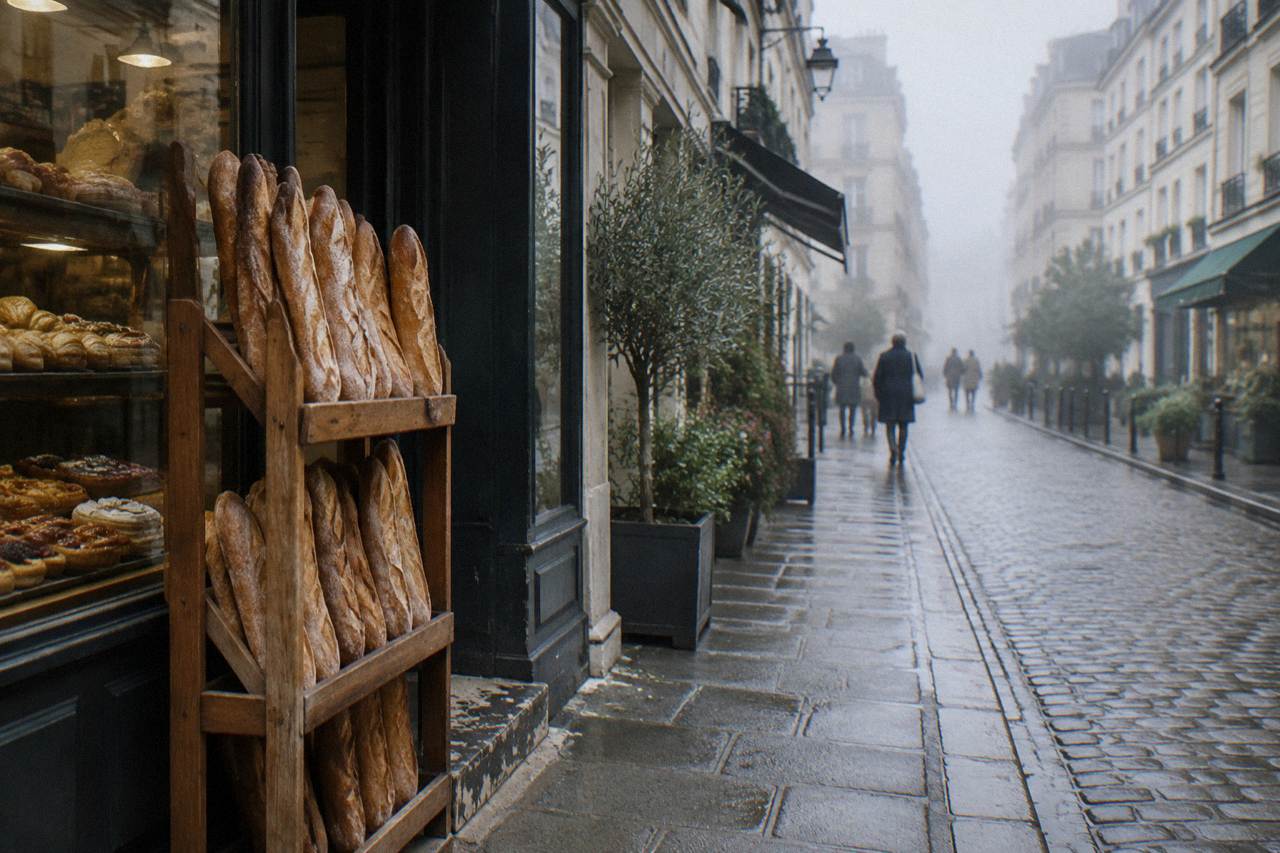
The baguette tradition is the backbone of Paris eating because it anchors the jambon-beurre, the cheese course and the bakery breakfast, and its craft is now UNESCO-inscribed. The 2026 city Grand Prix drew 143 baguettes and crowned Fournil Didot in the 14th arrondissement, proof that the loaf is a living competition, not a postcard.
The practical version of this is simple: buy a baguette tradition rather than a standard baguette if the counter offers both. The tradition label implies a slower process and no additives, which is why it carries a small premium over the 1.32 EUR city average. If you want to go deeper on bakeries, the site's guide to the best bakeries in Paris covers where to look by neighborhood.
The jambon-beurre deserves its own sentence because it is the proof of the baguette. Good ham, good butter, a crusty half loaf, nothing else, and it is the most-sold sandwich in France. You will pay a few euros at a counter, and any market street with a butcher and a baker next to each other will assemble one.
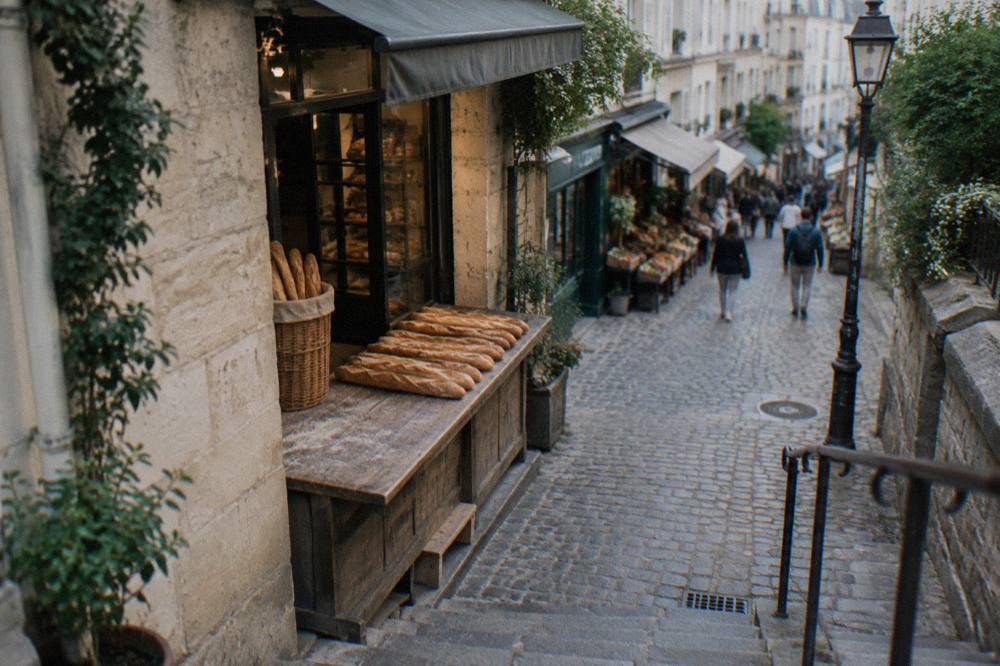
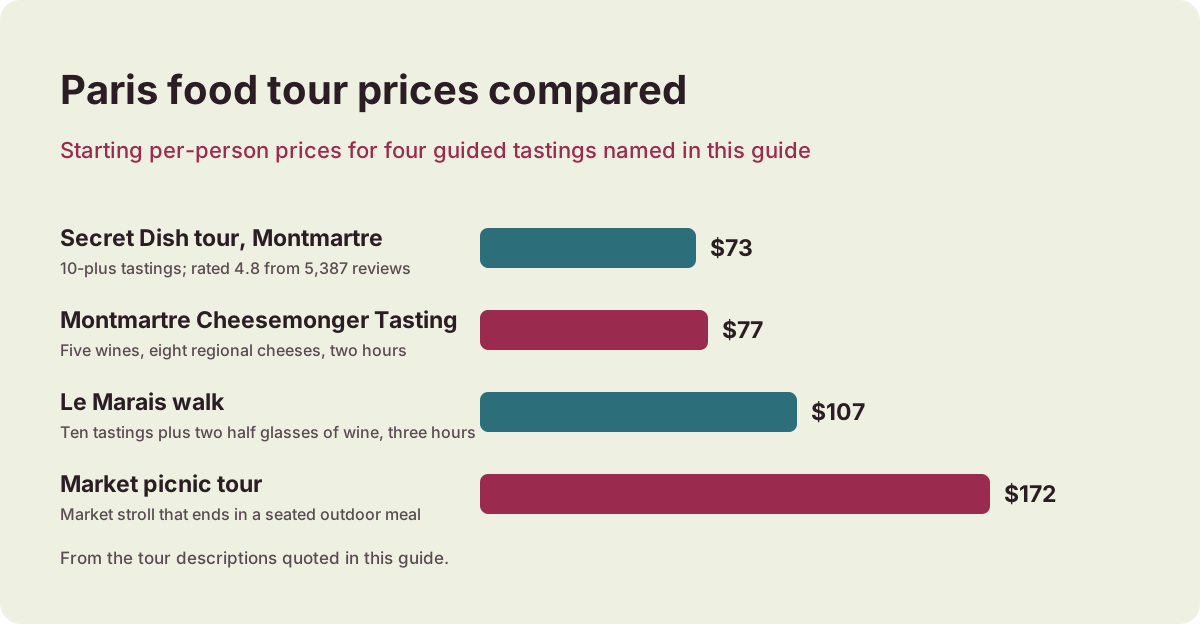
A walking tour is the fastest way to taste bread in context rather than in isolation, since a guide pairs it with cheese and charcuterie from nearby stalls. The Secret Dish tour run by Secret Food Tours is built exactly this way, with artisanal French cheeses and freshly baked breads among its ten-plus stops, from $73 per person and rated 4.8 from 5,387 reviews.
The three walks above cover different slices of the twelve-dish list: the Montmartre tastings walk leans on bread, cheese and pastry, the Le Marais walk by Devour Tours adds two half glasses of wine to its ten tastings from $107 per person, and the market picnic option by With Love From Paris Tours turns a market stroll into a seated outdoor meal from $172 per person.
How Do You Order Cheese Like A Parisian?
Order cheese as a course, not a starter, and expect it after the main and before dessert in a traditional meal. France carries 51 AOP and 12 IGP protected dairy products according to the INAO's 2024 figures, so a Paris cheese plate is a regional map, and fromageres will cut to order from raw-milk wheels.
The rule that helps most in a shop is to say what you like rather than asking for "the best". Name a texture or a milk, soft, firm, goat or blue, and let the counter build a plate of three to five pieces. A good fromagerie will ask when you plan to eat it, because ripeness is timed, and will refuse to sell you an underripe piece for tonight.
Paris cheese culture is not static, and 2026 has tested it. A historic drought prompted temporary rule changes approved by the INAO for several AOP cheeses including Cantal, Bleu d'Auvergne, Fourme d'Ambert, Reblochon and Rocamadour, and trade reporting says 38 of 65 French dairy AOP and IGP bodies are weighing permanent recipe changes to adapt to the climate. Expect shopkeepers to talk about it, and expect mild vintage variation in the years ahead.
If you would rather have the pairing explained than work it out alone, seated tastings do exactly that. The Montmartre Cheesemonger Tasting by EATCHEESEWITHMAX pours five wines including one sparkling against eight regional cheeses for two hours, from $77 per person, rated 5 from 793 reviews, and the roster prints as much fresh baguette as you want alongside.
The site's wider comparison in the wine and cheese tours guide lines up every seated tasting on the roster by price, cheese count and cellar location if you want the full field.
Not ready to commit hours to a cellar? The Le Marais walk above builds wine into a street-level tasting route instead, with ten-plus food stops and two half glasses across three hours, free cancellation up to 24 hours before the start.
Which Pastries Should You Eat First: Croissants Or Macarons?
Start with the croissant, because it is the daily pastry Parisians actually buy, then move to macarons, which are the gift and special-occasion tier. A neighborhood croissant costs 1.20 to 1.60 EUR, while boxed macarons run 21 EUR for six at a historic house, so the croissant is the cheap habit and the macaron the splurge.
The croissant test is simple: it should shatter, leave butter on your fingers and weigh almost nothing. The plain croissant outperforms the chocolate version in most bakeries because there is no filling to hide behind. For a deeper dive into loaf-shaped laminated pastry and where to find it neighborhood by neighborhood, see the site's best croissants in Paris guide.
Macarons are a different exercise. The shells are judged on a thin crust and a chewy interior, and the big houses sell by the box: Laduree's box of six lists at 21 EUR, and Pierre Herme's box of forty at 116 EUR. Angelina sells single grand macarons from 6.50 EUR if you want one without committing to a box. The site's best macarons in Paris guide sorts the houses by style.
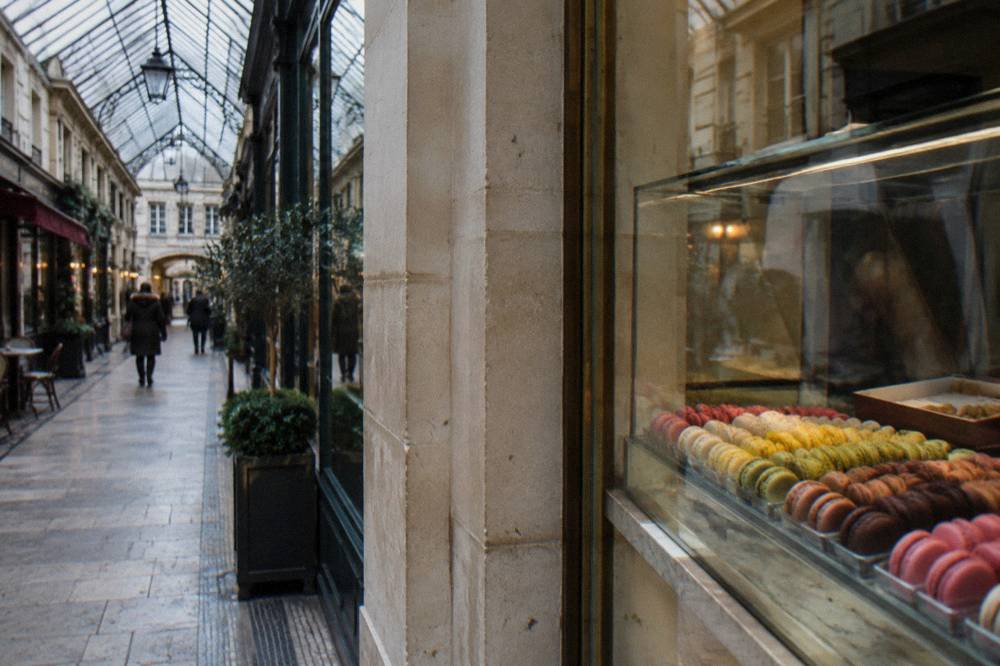
A guided pastry walk compresses this education into one morning. The Pastry and Chocolate Walk by Devour France Food Tours runs two and a half hours through the covered passages near the Grands Boulevards, with six-plus tastings, croissants and macarons among them, from $90 per person and a perfect 5 from 368 reviews. One guest review on the listing calls it simply: "I enjoyed walking around discovering unique pastry and chocolate places."
If you would rather make the pastry than only eat it, the site's pastry classes in Paris guide covers hands-on croissant and macaron workshops, including a three-hour croissant class from $134 per person with a maximum of eight students.
What Are The Bistro Classics And When Should You Order Them?
Order onion soup as a starter, steak frites for a quick midweek dinner, boeuf bourguignon for a Sunday lunch, escargots at a brasserie and duck confit when the menu looks Southwest-leaning. Each is a fixed point of bistro cooking, and all five appear on virtually every traditional menu in the city, so geography matters less than turnover.
The honest signal in a bistro is turnover, not location. A kitchen that sells twenty onion soups a night makes better onion soup than one that sells two, so look for the dish listed under plats du jour and order that. French law requires menus to be displayed outside from at least 11:30 for lunch and 18:00 for dinner, so you can read the whole offering before committing to a table. Everything else covered here is indexed on Paris Food Tours.
Boeuf bourguignon rewards the slow days. It is a braise, which means it is made ahead and improves sitting, so a Sunday lunch service is where it shines. Duck confit follows the same logic, the leg is cured and preserved in fat before service, and it pairs with the potato dishes that French kitchens do better than almost anyone.
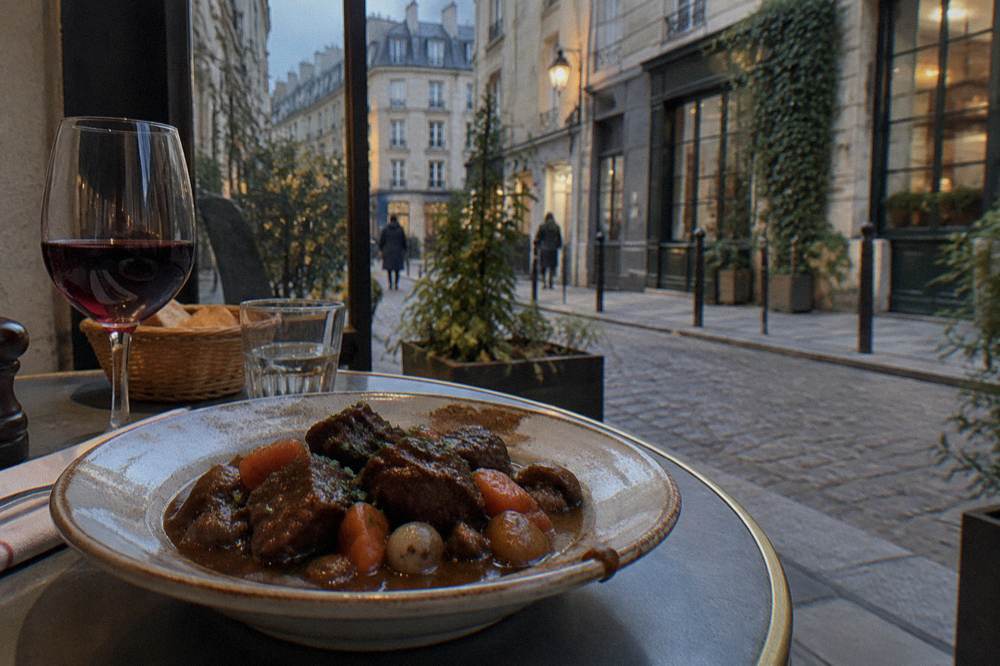
One roster tour turns the bistro classics into a moving meal. The Montmartre Full Meal Walk by Do Eat Better is an itinerant full meal rather than a tasting hop, 3 hours 30 minutes with at least one glass of wine included, from $102 per person and rated 4.9 from 1,713 reviews. A verbatim guest review on the listing reads: "The food was yummy and I loved the mixed in city explprations too! Kathryn was fun, friendly, and informative guide."
Vegetarian readers should know the bistro classics above are the least adaptable tier of the list, and the roster's own listings flag this: the Do Eat Better walk states vegetarian options are available but that life-threatening food allergies unfortunately cannot participate, while the Devour Marais tour says it is adaptable for vegetarians and pescatarians. Confirm with the operator before booking, always.
Where Does Street Food Fit: Falafel, Crepes And Market Stalls?
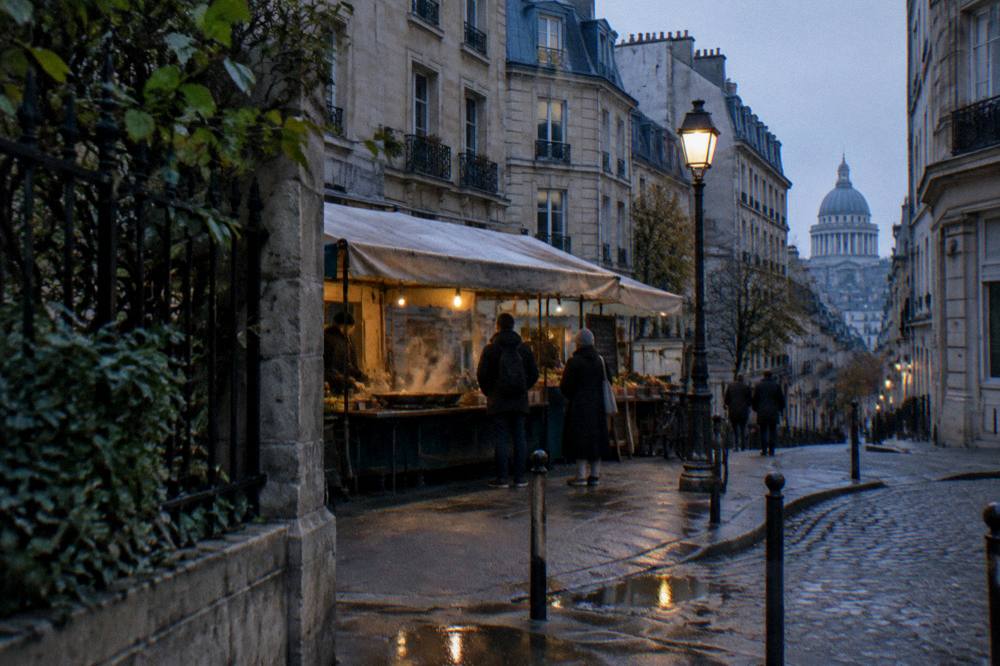
Rue des Rosiers in Le Marais is the falafel capital, with a full falafel sandwich listing at 10 EUR, crepes belong to the dedicated creperies and market stalls, and the covered markets anchor the whole street-food layer. All Paris food markets close on Mondays, so street eating runs Tuesday to Sunday.
The falafel line on Rue des Rosiers is a genuine Paris institution, an Ashkenazi and Sephardic food culture that has anchored the street for generations. Sacha Finkelsztajn at number 27 has operated since 1946, serving Ashkenazi pastries, and L'As du Fallafel at number 34 lists a falafel sandwich at 10 EUR, closed Saturdays, open Sunday through Thursday 11:00 to 23:30 and Friday until 15:30.
Crepes split into two foods. Galettes are the buckwheat savory version with ham, egg and cheese, and crepes are the sweet wheat version with sugar, jam or chocolate. A sit-down creperie is the sit-and-order experience; a market-window crepe is the walk-and-eat one, and both are legitimate.
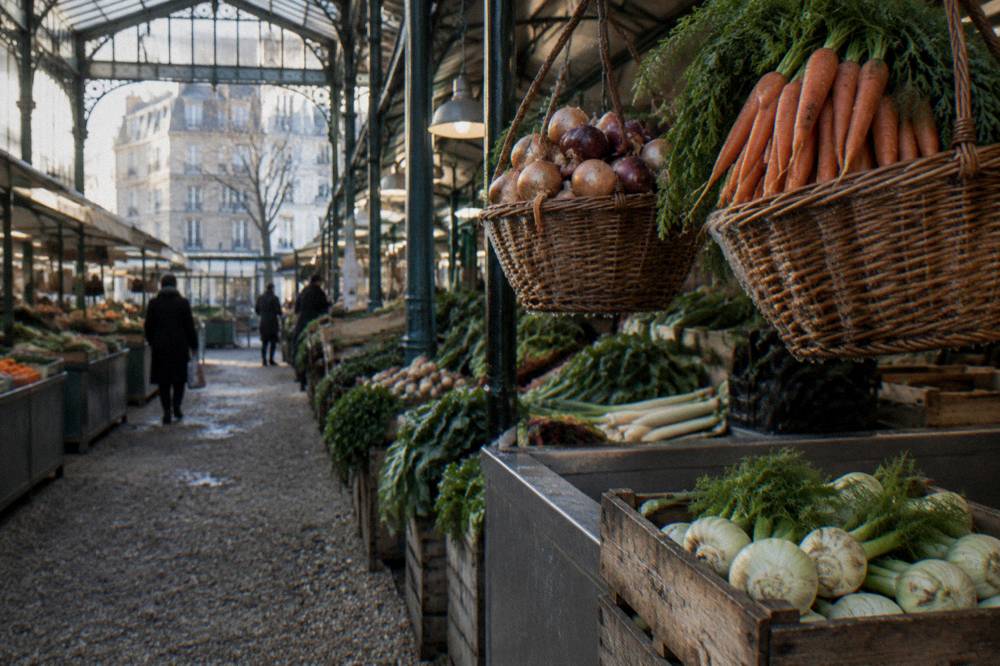
The market layer is where the twelve-dish list overlaps most with daily Paris life. The city runs 83 food markets, 74 open-air and 9 covered, per the city's own count, and the official Paris market list prints every schedule. Two standouts for visitors: Marche d'Aligre in the 12th runs Tuesday to Sunday with its covered Halle Beauvau open Tue-Fri 8h to 13h and 16h to 19h30, and Marche des Enfants Rouges in Le Marais, founded in 1615, is the oldest covered market in the city, open Tue-Sat 8h30 to 20h30 and Sun 8h30 to 17h. The site's Paris food markets and market tours guide covers more of them.
| Market | Arrondissement | Days | Hours | Character |
|---|---|---|---|---|
| Marche d'Aligre (open-air) | 12e | Tue-Fri | 7h30 to 13h30 | Produce, brocante, ethnic foods |
| Marche d'Aligre (Halle Beauvau) | 12e | Tue-Fri | 8h to 13h, 16h to 19h30 | Butchers, cheese, covered hall |
| Marche des Enfants Rouges | 3e | Tue-Sat | 8h30 to 20h30, Thu to 21h30 | World cuisines, oldest covered market |
| Marche Bastille | 11e | Thu and Sun | 7h to 14h30 weekend | Produce, fish, flowers |
| Marche Raspail (organic) | 6e | Sun | 7h to 14h30 | About 50 certified organic stalls |
All listed Paris markets close on Mondays, which is citywide policy rather than a coincidence, so plan market eating for any other day.
What Is In Season When You Visit?
Spring brings peas, asparagus, artichoke, rhubarb and strawberries; summer is melon, raspberry, courgette, aubergine and pepper; autumn opens squash season in October alongside apples, pears, figs and plums; winter shifts to citrus from December plus leeks, endive and parsnip. Buying in season at a Paris market costs less and tastes better.
The seasonal calendar matters more in Paris than in cities with year-round import culture, because market stalls still follow the French growing regions and the menus change with them. An October visitor gets figs and the first squash; a May visitor gets asparagus done a dozen ways. The calendar below is the French produce industry's own grouping, and it is a reliable planning tool for any month.
| Season | Produce at its peak |
|---|---|
| Spring | Peas, asparagus, artichoke, rhubarb, strawberry |
| Summer | Melon, raspberry, courgette, aubergine, pepper |
| Autumn | Squash from October, apples, pears, figs, plums |
| Winter | Citrus from December, leeks, endive, parsnip |
Cheese follows a quieter version of the same calendar, and the drought-driven rule changes of 2026 make vintage variation more likely, so a fromager who says this year's Beaufort tastes different from last year's is making a factual claim, not a sales pitch. The INAO's dairy key figures page is the primary source for the protected-product counts.
Which Guided Tour Tastes Which Dishes?
The ten-plus tastings walk covers baguette, cheese, crepes and macarons in one route; the full-meal walks cover bistro classics like boeuf bourguignon; seated tastings cover the cheese course in depth; market tours cover street food and picnic buying. Matching the tour type to the dishes you most want to eat is the fastest way to choose.
The roster on this site splits cleanly along the twelve-dish list. Walking tours in Montmartre and Le Marais hit the bakery and cheese tier; the meal-included walks hit the bistro tier; cellar tastings hit the dairy tier; market tours hit the street tier. The table below shows the overlap using the roster's own printed details.
| Tour (decision name) | Dishes it samples | Meal included | From (USD) | Rating and reviews |
|---|---|---|---|---|
| Secret Dish, 10+ Tastings | Cheeses, breads, crepe, macarons, secret dish | No | $73 | 4.8 from 5,387 |
| Le Marais, 10 Tastings | 10+ tastings, 2 half glasses of wine | No | $107 | 4.8 from 809 |
| Montmartre Full Meal Walk | Itinerant full meal, boeuf bourguignon tier, wine | Yes | $102 | 4.9 from 1,713 |
| Montmartre Cheesemonger Tasting | 8 cheeses, 5 wines, baguette | No | $77 | 5 from 793 |
| Market Stroll, Picnic | Market picnic treats, wine or champagne | No | $172 | 5 from 24 |
| Pastry and Chocolate Walk | 6+ pastry and chocolate tastings | No | $90 | 5 from 368 |
Duration matters as much as content. The short walks run two to three hours, the full-meal walk runs three and a half, and a full-day cooking class with market tour and lunch runs six hours from $246 per person if you want to cook the list rather than only eat it. The site's cooking classes in Paris guide covers that tier in full.
How Much Should You Expect To Pay For Each Dish?
The bakery tier is cheap: 1.32 EUR is the average Paris baguette tradition and 1.20 to 1.60 EUR buys a croissant. The street tier sits near 10 EUR for a Rue des Rosiers falafel. The pastry-gift tier jumps: 21 EUR for six boxed macarons at a historic house. Guided tours run from $38 for a 105-minute market tasting to $246 for a full-day class.
These benchmarks come from the site's verified research files, and they hold as planning ranges rather than guarantees, since every counter sets its own price. The baguette average is a 2026 citywide figure that climbs to 1.34 to 1.37 EUR in the more central and western districts, and the croissant band reflects neighborhood boulangeries rather than palace-hotel pastry counters.
| Item | Planning price | Note |
|---|---|---|
| Baguette tradition | 1.32 EUR average | 1.34 to 1.37 EUR in central-western districts |
| Croissant | 1.20 to 1.60 EUR | Neighborhood boulangeries |
| Single grand macaron | from 6.50 EUR | Angelina listing |
| Box of 6 macarons | 21 EUR | Laduree listing |
| Baba au rhum | 6.10 EUR | Stohrer listing |
| Falafel sandwich | 10 EUR | Rue des Rosiers listing |
| Guided market tasting | from $38 per person | 105 minutes, Bastille |
| Guided tastings walk | from $73 to $107 per person | Two to three hours, small group |
Two layers sit above these bands. Tipping is optional because service is already included in displayed French menu prices, a point the site's tipping in Paris restaurants and tours guide explains with the legal detail. And the class tier, from about $103 for a two-hour baking experience up to $246 for a full-day class with lunch, buys skills rather than a meal, which is a different purchase entirely.
If the cheese course is the one you most want to understand, the seated cheesemonger tasting above is the cheapest deep dive on the roster at from $77 per person, and it covers eight cheeses and five wines in a single two-hour sitting. For everything else, the three walks below remain the quickest routes through the widest slice of the twelve-dish list.
Common Questions About What To Eat In Paris
What are the twelve dishes to eat in Paris?
Baguette, jambon-beurre, croissant, a raw-milk cheese plate, macarons, crepes, French onion soup, steak frites, boeuf bourguignon, falafel, escargots and duck confit. Each is an everyday food in Paris, and together they cover bakery, dairy, street food and classic bistro cooking.
How much does a croissant cost in Paris?
A croissant at a neighborhood boulangerie costs 1.20 to 1.60 EUR. The average baguette tradition is 1.32 EUR, rising to 1.34 to 1.37 EUR in the more central and western districts.
Where should I eat falafel in Paris?
Rue des Rosiers in Le Marais. L'As du Fallafel at number 34 lists a falafel sandwich at 10 EUR and is closed Saturdays, open Sunday to Thursday 11:00 to 23:30 and Friday until 15:30.
Are Paris food markets open on Mondays?
No. All listed Paris food markets close on Mondays, citywide. Marche d'Aligre, Marche des Enfants Rouges and the rest run Tuesday to Sunday on their printed schedules.
Which food tour covers the most of these dishes?
The Secret Dish, 10+ Tastings walk by Secret Food Tours covers cheeses, breads, a Brittany crepe, macarons and a secret dish in one route, from $73 per person, rated 4.8 from 5,387 reviews. The Montmartre Full Meal Walk adds bistro classics with a full meal included.
Do I need to book a tour to eat well in Paris?
No, but a guided tasting compresses the learning. A tour such as the ten-plus tastings walk puts bread, cheese, crepe and macaron in context with a guide in two to three hours, which most visitors cannot assemble alone on a first trip. Book only what you will use, and check the cancellation terms on each listing.