What Is The Proper Way To Eat A Croissant In France?
Croissant etiquette in France explained: hands or fork, butter or jam, when to eat one, and what locals actually do, with current Paris croissant prices.
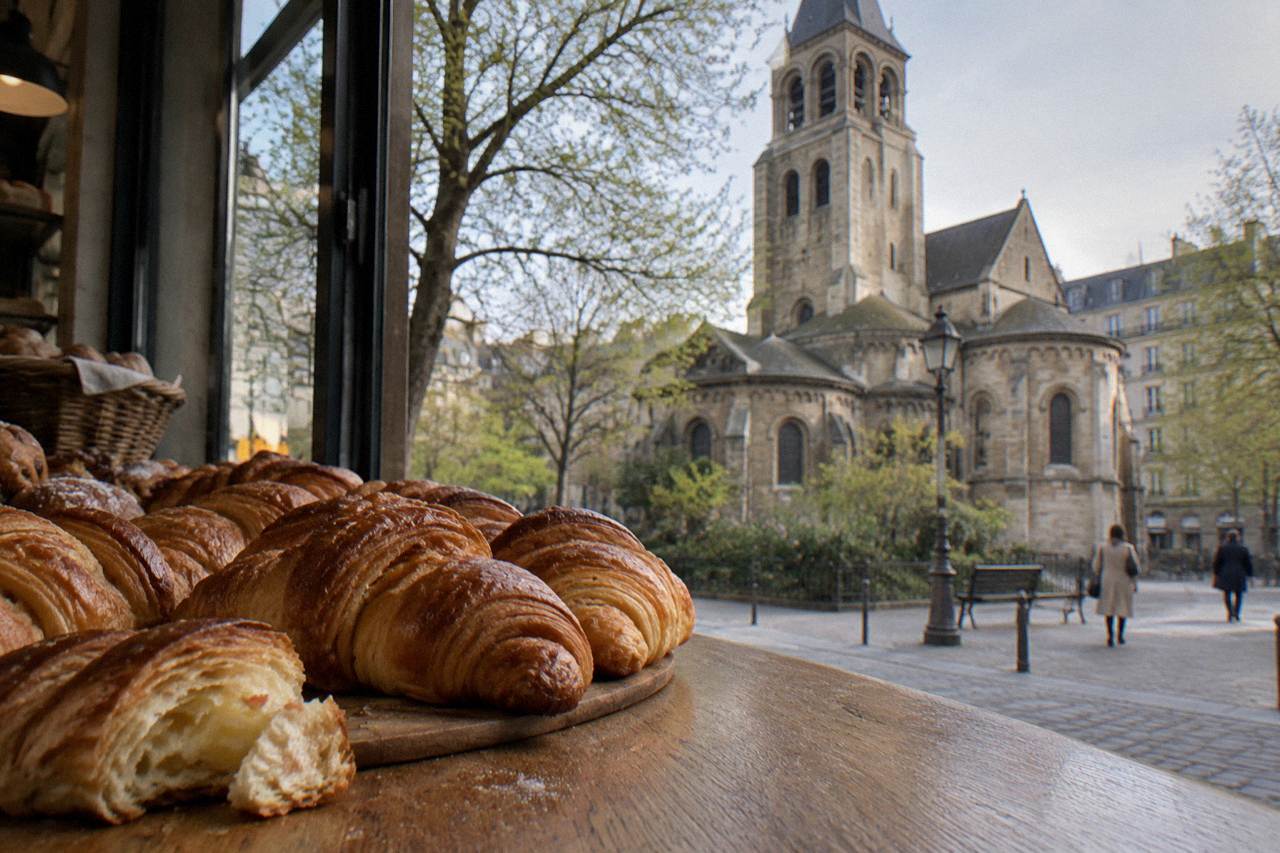
A croissant, a small coffee, and a bistro table: this is the image Paris sells to the world, and mostly it is true. But visitors arrive with a bundle of half-remembered rules, some real, some invented, about how the pastry should be handled. Should you tear it or cut it? Is butter allowed? Is dunking a crime?
This article works through the etiquette as the French actually practice it, separating documented custom from internet folklore. Along the way it covers when croissants are eaten, what they cost in Paris right now, the mistakes that read as tourist tells, and a hands-on route for travelers who would rather learn the lamination than just obey the rules: a croissant baking class with a working pastry chef. Once you have the etiquette down, the next question is where to buy that morning croissant, and our guide to the bakeries and markets where Parisians actually shop answers it with real market hours and weekday lunch habits.
What Is The Proper Way To Eat A Croissant In France?
The proper way is to eat a croissant with your hands, at breakfast or mid-morning, torn or bitten in pieces rather than sliced with a knife, and usually plain or with a modest swipe of jam. Butter is uncommon because the pastry is already rich with it. It is a casual food, not formal dining, so strict rules barely exist. That is the short version, and everything after it is nuance. The croissant belongs to the category of foods the French eat by hand without a second thought, like a piece of baguette or a market peach. Nobody at the next table is monitoring your technique. What does get noticed, gently, is treating a croissant like a formal dessert course: sawing it with a knife, spreading it thickly with butter, or ordering it alongside a three-course lunch.
The pastry itself is a breakfast and goûter item, tied to the morning bakery run. Bakeries sell the largest share of their croissants before 10 a.m., and the standard French breakfast, the petit déjeuner, is a small affair: a croissant or tartine, coffee or hot chocolate, juice perhaps. A croissant at 4 p.m. with a snack is equally legitimate, especially for children. The idea that there is one solemn ceremony is the part that is invented.
If the etiquette angle makes you curious about the craft itself, the natural next step is a class rather than another bakery queue. Three options below cover the range: the full croissant class, a guided pastry walk through the covered passages, and a shorter all-round baking experience.
Do You Eat A Croissant With Your Hands Or With A Fork?
With your hands, in almost every real-world setting. A croissant is a finger food in France, whether you are standing at the bakery counter or seated at a café table. Using a knife and fork reads as odd, and slicing one open like a sandwich bun is rarer still. Tearing bite-sized pieces is the customary motion. The one nuance worth knowing is that cafés do set out cutlery, and nobody will intervene if you use it. French tolerance for individual eating styles is high in casual settings. What the custom actually shows is context: a croissant is viennoiserie, a morning pastry, grouped with the pain au chocolat and the chausson aux pommes rather than with fork desserts like the mille-feuille.
Tearing rather than cutting has a practical logic too. A well-laminated croissant is dozens of thin butter layers, and a knife compresses them. Tearing along the pastry's natural seams keeps the honeycomb structure visible, which matters in a country where the interior crumb, the mie, is judged as closely as the crust. A French baker describing an ideal croissant talks about the alveolage, the open irregular holes inside, the way a wine person talks about legs on a glass.
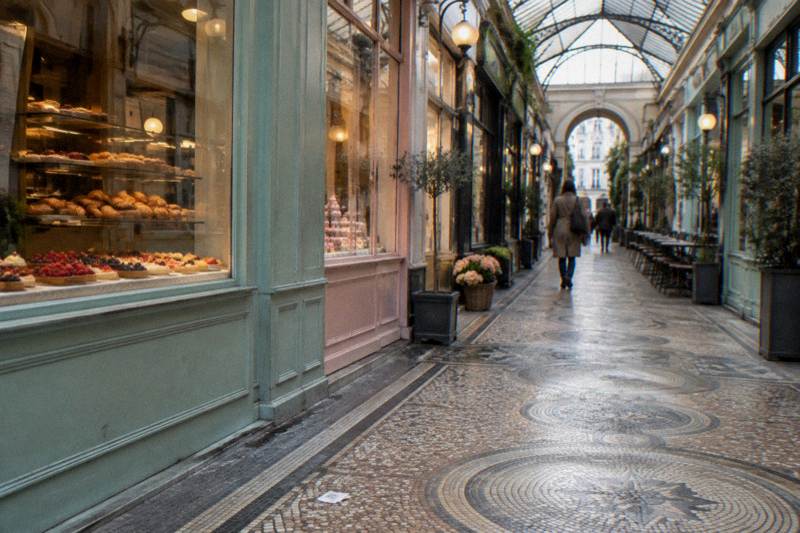
Flakes are part of the deal. Locals accept that eating a croissant sheds pastry snow on the plate, the table, and occasionally the sweater. Brushing them into a small pile on the edge of the plate is normal; chasing every crumb with a finger is not. If you want to see what a serious crumb structure looks like before forming opinions, the pastry walks through the Grands Boulevards passages visit bakeries whose entire reputation rests on lamination.
One etiquette-adjacent habit that genuinely differs from North American norms: the French do not generally eat while walking. Buying a croissant and eating it on the move is common among commuting locals, but sitting for ten minutes at the counter or on a bench is the more customary rhythm, and it is a better experience anyway.
Butter, Jam, Or Plain: How Do The French Dress A Croissant?
Most often plain, straight from the bag. When something is added, it is jam, typically apricot or strawberry, spread thinly on torn pieces. Butter on a croissant is the famous exception rather than the rule: the pastry is already roughly a quarter butter by weight, so adding more strikes many French eaters as redundant. The butter-on-croissant habit is real in one specific place, Brittany, where the croissant au beurre tradition overlaps with the region's salted-butter culture, and a croissant labelled au beurre is distinguished from the cheaper croissant ordinaire made with margarine, a holdover label from earlier French price regulations. That label is about what is inside the dough, not what you spread on it.
Jam is the accepted accompaniment at hotel breakfasts and cafés, and at home on weekends. The method is small: a dab on each torn piece, not a full coating of both halves as if assembling a sandwich. Honey plays the same role, especially with a plain croissant and a coffee. Chocolate spread exists on family breakfast tables, though purists consider a croissant a poor vehicle for it, since it is already a butter delivery mechanism. Neither sweet topping belongs on a savory stop like a ham-filled croissant, which some bakeries sell at lunch.
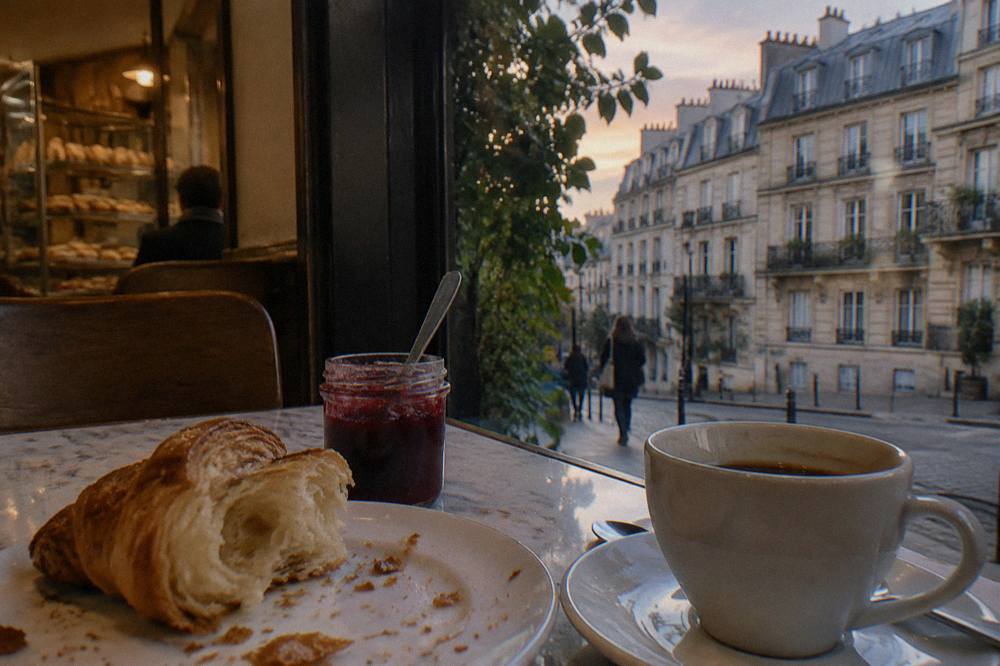
The drink pairing matters as much as the topping. Coffee, usually an espresso-length café or a noisette, or a bowl of hot chocolate for children, is the classic pairing. Orange juice appears at hotel breakfasts. What you will not see as a customary pairing is a large takeaway latte, and the reason is practical: a croissant is eaten within a few meters of where it was bought, not carried across a neighborhood.
When Do The French Eat Croissants, And How Many?
Croissants are a morning food, eaten at breakfast and bought fresh the same day, with a second window in the mid-afternoon goûter snack, especially for children. They are not an all-day pastry, and they are rarely eaten at lunch or dinner. A single croissant is a normal portion; a second is a weekend indulgence. The morning bakery run is a genuine daily ritual, and it explains a quirk visitors often notice: by early afternoon, bakery croissant trays are thin or empty, and that is by design, not under-stocking. Viennoiserie is made for the day it is sold. Stale croissants are not refreshed; the day's leftovers at some bakeries become pain perdu or are simply gone by evening.
The weekend dimension is strong. The Sunday morning family bakery trip, often with a baguette under one arm and a paper sleeve of croissants and pains au chocolat in hand, is one of the more durable French food rituals. Weekday breakfasts at home are more often toast or cereal, with the croissant reserved for days with a little more time. The pastry also anchors hotel and café breakfasts across the country, where the petit déjeuner formula, coffee, juice, bread with jam, and a croissant, is close to standardized.
The table below gives current Paris price context, useful for knowing what a normal croissant costs before you order.
| Item | Paris price benchmark | Notes |
|---|---|---|
| Croissant at a neighborhood boulangerie | 1.20 to 1.60 EUR | Range recorded across Paris |
| Average croissant price citywide | 1.22 EUR | Survey of more than 100 addresses, hedged as one survey figure |
| Baguette tradition, for comparison | 1.32 EUR average | Paris average, higher in central arrondissements |
| Box of 6 macarons at a grand maison | 21 EUR | Included for scale against viennoiserie pricing |
Two of those figures are worth a link to their sources: the croissant range and average come from a current Paris croissant price tracker, and the survey average is reported by a French bakery price survey. For a longer look at croissant pricing, the companion piece on what a croissant should cost in Paris breaks the numbers down by neighborhood and bakery type.
Is Dipping A Croissant In Coffee Acceptable?
Dipping is tolerated at home and quietly common, but it is not elegant in public, and older French diners tend to view it as a habit for children. The truly dunked item in French culture is the tartine, bread with butter and jam, softened in a café au lait or hot chocolate from a bowl. A croissant dipped whole is a mess; dipped by the torn corner, it passes. This is the etiquette question where France splits most visibly by generation and setting. At a family breakfast table, a child softening a corner of croissant in hot chocolate draws no comment. At a café terrace, doing the same with an espresso, which comes in a small cup with barely an inch of liquid, looks impractical more than rude: there simply is not enough coffee to dunk into.
The practical reading most French people would give you is that dunking belongs to foods that benefit from it. Dry bread benefits. A croissant, whose entire point is crisp layers that go sodden in liquid, loses more than it gains. If the impulse is toward coffee-and-pastry in one gesture, the cultural version is the dunked tartine at home and the alternating sip-and-bite rhythm in public.
Visitors who want to sample a range of laminated pastry and chocolate work in one morning, with a guide narrating the etiquette and the history as they go, have a good option in the covered passages. The Pastry and Chocolate Walk by Devour France Food Tours, from $90 per person, rated 5.0 from 368 reviews, spends two and a half hours on croissants, macarons and iconic French desserts through Passage Jouffroy and Passage Verdeau, with six or more tastings for a group capped at 12. One guest review from that tour notes the guide "was knowledgeable about the history of Paris and the foods we ate" and that "the pace was nice and relaxed," which is roughly the frame you want for an etiquette-plus-tasting morning.
What Croissant Mistakes Mark You As A Tourist?
The reliable tells are eating a croissant while power-walking with a map, slicing it into neat rounds with a knife, asking for it warmed at 3 p.m. when the tray is finished, and treating the bakery queue as optional. None of these are offensive; they are simply legible. The fix is easy: buy in the morning, stand or sit nearby, eat by hand, and say bonjour on entering. That greeting matters more than any fork convention. Entering a French bakery and going straight to the counter without a bonjour is the single most remarked-upon tourist behavior in French service culture, and it colors every interaction that follows. A bonjour, a point at the pastry, a s'il vous plaît, and a merci will carry you through any bakery in the country.
Ordering has its own small mechanics. Croissants are usually behind glass or on trays behind the counter, so you point or name them; allongé or noisette for the coffee; and coins or card, though some small bakeries still post a card minimum, which is legal when visibly displayed at entry. The classic order is "deux croissants, s'il vous plaît," plural, because buying one for a companion is the norm. Asking for yesterday's croissant heated to revive it confuses the premise: the bakery is selling today's.
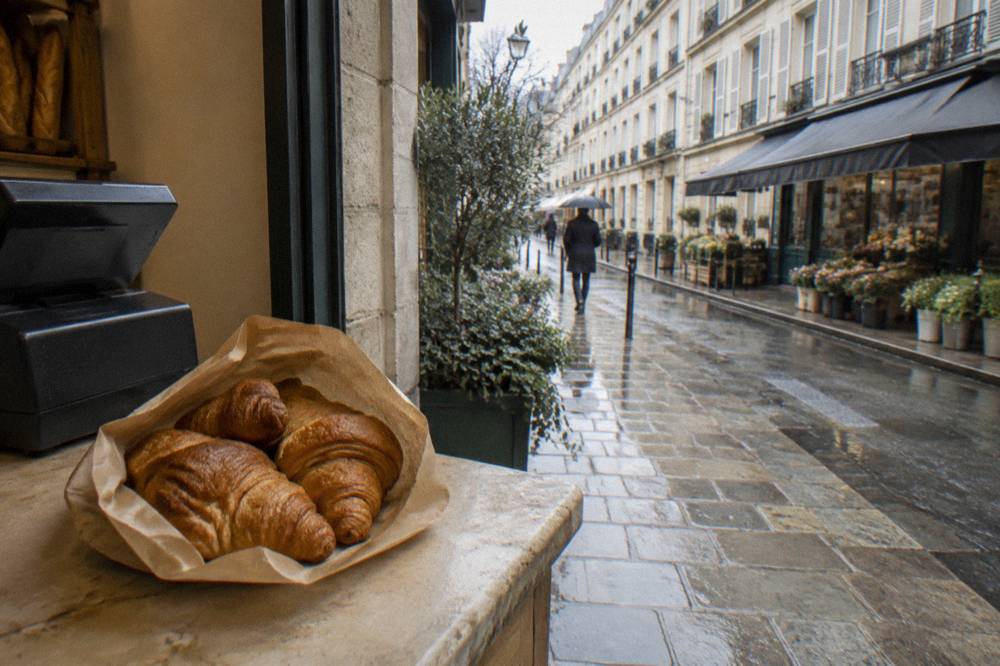
A subtler point is where to eat. The bench outside the bakery, the counter inside if there is one, or the nearest café terrace are all normal. The 20-minute walk back to the hotel with a flaking bag is the tourist pattern, because the croissant is at its best in the first half hour after baking. Visitors plotting a serious croissant crawl across the city can start from the site's own rundown of the best croissants in Paris, which orders the bakeries worth a detour.
Learn The Technique: A Croissant Class Instead Of A Bakery Queue
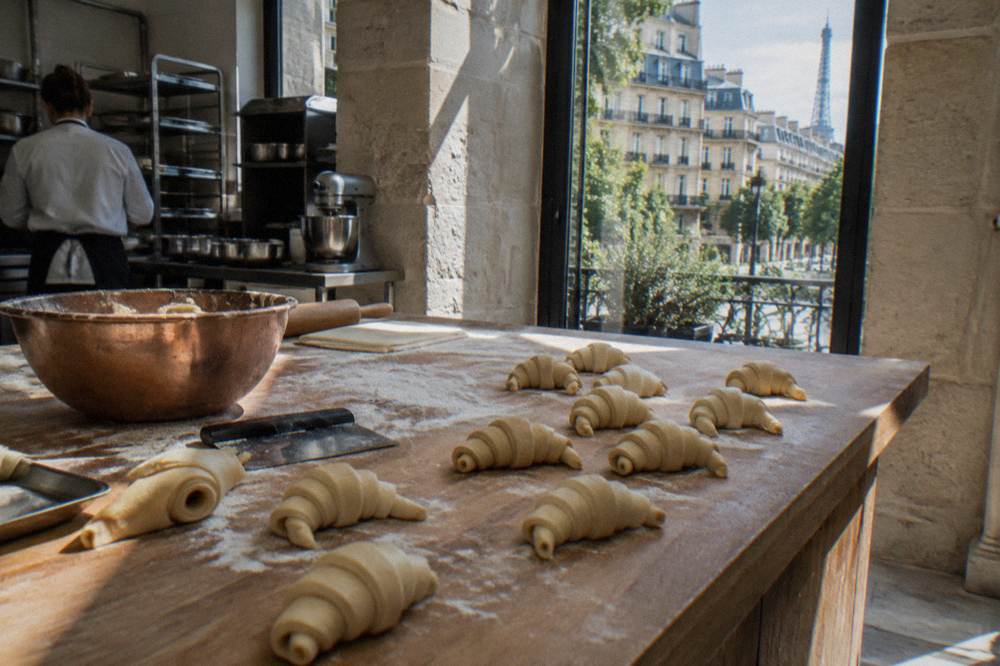
For travelers who finish reading about lamination and etiquette and want the real thing, a croissant baking class turns the morning ritual into a skill. You learn the dough, the butter block, the folds and the proofing, and you leave with your own croissants and the recipe logic behind them. It is the deepest version of respecting the pastry. The Croissant Baking Class by Studio Pâtisserie is the featured option here: three hours, limited to 8 participants, from $134 per person, rated 5.0 from 243 reviews, with Chef Léo guiding the full process, ingredients included, and access to professional-grade kitchen equipment. Children under 17 can join with a paying adult, per the listing. See the croissant class details on its tour page, and check availability there for your dates, since an 8-seat class fills on weekends.
A shorter, broader alternative is the Paris French Baking Experience by ExperienceFirst, from $103 per person, rated 4.9 from 255 reviews, which covers bread, croissant or macaron in two hours for a group capped at 8, with tastings along the way and creations to take home. The listing notes children are welcome with an adult and that kids under 5 can join free of charge, though they will not participate in the baking. One verbatim guest review from that experience describes it warmly: "We learned how to make and shape baguettes, croissants, and small cakes. We were able to sample items and take home are finished baguettes." A family review from the same listing adds, "What a wonderful experience my daughter and I had with Pierre at his bakery. We learned a lot about baguettes and got to make one and bring it with us…so good!" After you have shaped your own baguette, see how Parisians stock their kitchens every day in our guide to the bakeries and markets where locals actually eat.
The comparison below puts the three hands-on and guided options side by side.
| Experience | Price from | Rating and reviews | Duration | Group size |
|---|---|---|---|---|
| Croissant Baking Class (Studio Pâtisserie) | $134 per person | 5.0 from 243 reviews | 3 hours | Limited to 8 |
| Pastry and Chocolate Walk (Devour France Food Tours) | $90 per person | 5.0 from 368 reviews | 2.5 hours | Max 12 |
| French Baking Experience (ExperienceFirst) | $103 per person | 4.9 from 255 reviews | 2 hours | Max 8 |
The differences are about depth and format, not quality. The croissant class is the single-topic deep dive, the pastry walk is the guided tasting tour with no kitchen time, and the baking experience splits the difference in a working bakery setting. For a fuller treatment of the category, including macaron-focused options, see the guide to croissant making classes in Paris.
The Short Version Of The Rules
Tear, do not cut. Hands, not cutlery. Morning, not midnight. Jam if you like, butter rarely, dunking at home only. Say bonjour first, eat near the bakery, and buy in the morning while the layers still shatter. Everything beyond that is a style choice the French will not police. This site, Paris Food Tours, covers the city's food from markets to classes, and the through-line in every guide is the same one that governs the croissant: the French care enormously about how food is made, and only moderately about how any individual eats it. The croissant has been through centuries of argument among bakers about butter, shape, and ownership, but that argument happens in the bakery, not at the breakfast table.
What travelers remember, in reviews of both the classes and the walks, is rarely a rule they learned. It is the moment the layers came apart in their hands and the pastry was still warm from the oven. That is the actual proper way to eat a croissant in France: soon.
Common Questions About Eating A Croissant In France
What Is The Proper Way To Eat A Croissant In France?
With your hands, torn or bitten in pieces, usually plain or with a little jam, at breakfast or as a mid-afternoon snack. It is casual finger food, not a formal course, so knives, forks and ceremony are unnecessary.
Do the French put butter on croissants?
Rarely. The dough is already rich in butter, so most people eat it plain or with a thin spread of jam or honey. The "croissant au beurre" label in bakeries refers to real butter in the dough, not butter added at the table.
Is it rude to dip a croissant in coffee?
It is not rude, but it is considered informal and slightly childish in public. At home, plenty of people soften a torn corner in coffee or hot chocolate. In a café, the sip-and-bite rhythm is the customary choice.
Can you eat a croissant while walking in Paris?
You can, and commuters do, but seated or standing near the bakery is the more customary rhythm. The French generally do not eat on the move, and a croissant is at its best within half an hour of baking anyway.
When should you buy a croissant?
In the morning. Bakeries bake viennoiserie for the day, trays thin out by early afternoon, and there is no evening batch. The weekend family bakery run on Sunday morning is the ritual at its fullest.