Where Do Locals Eat In Paris?
A reporting guide to where Parisians actually shop and eat: official market hours, bakery prices, weekday lunch habits and the streets locals skip.
Parisians do not eat on the Champs-Élysées, and they do not shop for dinner at midnight convenience stores. The city runs on a rhythm of morning markets, a seated weekday lunch, a bakery stop that sometimes happens twice a day, and an evening that starts late at a wine bar or a corner bistro. The city's own market office counts 83 food markets, 74 open-air and 9 covered, and every one of them closes on Monday. That single fact does more to explain local eating habits than any list of famous restaurants. Eating like a local also keeps costs reasonable, and if you want to plan your spending, the day-by-day Paris food budget guide shows what bakeries, bistros and markets actually charge.
This guide reports what the official sources say: the market schedules published by the city, price surveys of baguettes and croissants, and the hours that bistros and wine bars actually keep. It also names the market-style guided walks that let a visitor step into that rhythm without guessing which stall to stop at.
Where Do Locals Eat In Paris?
Locals eat at the city's 83 food markets in the mornings, at weekday formule lunches between noon and 2:30pm, at neighbourhood bakeries for a 1.32 EUR baguette tradition, and at natural wine bars in the evening, where glasses typically run 5 to 12 EUR. Almost all of it happens away from the Boulevards and the museum queues, in the 3rd, 5th, 10th, 11th and 12th arrondissements.
The honest answer is that "where locals eat" is mostly a question of when. A Parisian's food day is scheduled: markets before 13h30, lunch starting at noon sharp, dinner rarely before 19h30. Visitors who match the clock find the local city almost by accident. Arrive at Marché d'Aligre at 9am on a Saturday and you will be standing elbow to elbow with people carrying string bags, not cameras.
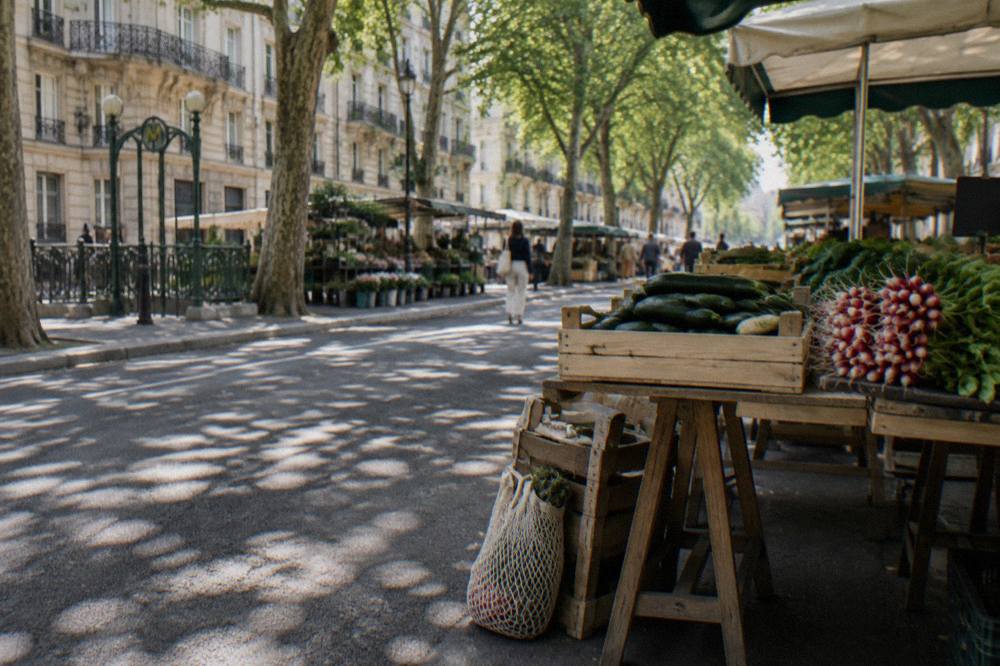
Three of this site's market-style walks follow exactly this rhythm. The Market Stroll, Picnic tour from With Love From Paris Tours takes a small group of up to 10 through a local market and turns the haul into a picnic with wine, from $172 per person. The Aligre Market, 2 Hours walk from Original Food Tours covers the Bastille market area with tastings from $126. The History Walk, Market Meal tour from Le Paris de Sophie starts at Île de la Cité and ends with lunch, from $217 per person. If wandering the stalls leaves you eager to cook the haul yourself, our breakdown of Paris cooking class lengths explains what each option covers and how to fit one into your day.
Which Food Markets Do Parisians Actually Shop At?
The locals' markets are Aligre in the 12th, Raspail's organic Sunday market in the 6th, Bastille on Thursday and Sunday mornings, Monge in the 5th on Wednesday, Friday and Sunday, and the covered Enfants Rouges in the 3rd. All of them close on Monday, and most finish by 13h30 or 14h30, so a late start means an empty square.
The city publishes the schedules, and they are worth trusting because market hours in Paris are set, not suggested. Morning markets open at 7h and run to 13h30 on weekdays, until 14h30 at weekends. Marché d'Aligre, one of the few to run both a covered hall and an outdoor strip, is the classic locals' market: the covered Halle Beauvau opens Tuesday to Friday from 8h to 13h and 16h to 19h30, Saturday 8h to 19h30, Sunday 8h to 13h30, and the outdoor stalls trade from 7h30. A city guide notes the market has drawn a cosmopolitan mix of produce, brocante and ethnic foods since the 18th century, and that traders often stay open past the official hours. Once you've gathered your market supplies, a fresh croissant from a nearby boulangerie rounds out the morning, and the guide to how locals actually eat croissants in France settles the hands-versus-fork question.
| Market | Arrondissement | Days and hours (official) | Character |
|---|---|---|---|
| Marché d'Aligre (outdoor) | 12e | Tue to Fri 7h30 to 13h30, Sat-Sun 7h30 to 14h30 | Cheapest produce, brocante, locals' market |
| Halle Beauvau (covered) | 12e | Tue-Fri 8h-13h and 16h-19h30, Sat 8h-19h30, Sun 8h-13h30 | Butchers, cheese, wine |
| Marché des Enfants Rouges | 3e | Tue-Sat 8h30-20h30 (Thu to 21h30), Sun 8h30-17h | Oldest covered market, founded 1615, world cuisines |
| Marché Bastille | 11e | Thu 7h-13h30, Sun 7h-14h30 | Big weekly market, produce, fish, flowers |
| Marché Raspail bio | 6e | Sun 7h-14h30 (organic), Tue and Fri 7h-13h30 (traditional) | Around 50 certified organic stalls |
Enfants Rouges deserves its own line because it is the oldest covered market in Paris, founded in 1615, and because it doubles as an evening eating spot: food stalls, no reservations, and the tourist office warns it is busiest between 12h and 14h30. Raspail's Sunday organic market, one of four 100% organic markets in the city, was the first major organic market in Paris and gets crowded well before 11h. The full official list, including the rule that every market closes Monday, is on the city's market pages.
A few practical habits will make you look less like a first-timer. Bring your own bag, since stallholders rarely hand them out, and bring cash as well as a card, because plenty of traders still prefer coins and small notes. Queue behind the locals rather than hovering at the front of the stall, and let the vendor pick your produce: pointing, grabbing and squeezing your own fruit is the fastest way to get a cool reception. If your French is shaky, a simple "bonjour" when you arrive and "merci" when you leave covers most interactions, and vendors will often offer a taste before you buy.
Timing matters almost as much as manners. The last half hour before closing is when prices drop, because traders would rather sell cheap than cart unsold stock home, so around 13h you can pick up ripe fruit and end-of-day bargains. The trade-off is that the best selection is gone by then, so shop early for choice and late for price. If you are assembling a picnic, do a loop of the whole market before buying anything: prices for the same tomatoes or strawberries can vary noticeably from one end of the row to the other.
If you would rather eat on the spot than cook, several markets have cooked-food stalls where you can stand and eat, and Enfants Rouges is the best known of them. For a sit-down version of the same experience, a bistro formule déjeuner, a set two-course lunch menu, typically runs 15 to 25 EUR and is served in the early afternoon, so it pairs well with a morning spent shopping the stalls. Either way, the markets are at their liveliest mid-morning, which is exactly when the locals do their own shopping, and that is the best sign you have found the right one.
Where Do Locals Eat Lunch On A Workday?
Locals eat lunch between noon and about 2:30pm, when most kitchens close, and the weekday habit is the formule déjeuner: a two-course set menu at 15 to 25 EUR at a decent bistro. Restaurants must display menus outside from 11:30 for lunch, so the local ritual is reading the street before choosing a table.
The formule is the engine of Parisian lunch. It is a fixed-price menu, usually two courses, sometimes with a coffee, priced well below the à la carte card. One city guide puts the range at 15 to 25 EUR for two courses in 2026, and notes that Michelin-starred venues often run fixed-price lunch menus far cheaper than dinner, around 32 EUR for two courses at one-star level. Locals know this and book the starred dining rooms for lunch, not dinner.
The legal framework helps the visitor too. A mandatory 15% service charge is included in all displayed menu prices, so nobody will chase you for a tip, and an optional pourboire of 1 to 2 EUR per person is the common gesture at casual meals. Restaurants must also provide a free carafe of tap water on request to customers eating on site, a rule that dates to a 1967 arrêté covering bread and ordinary water. Order "une carafe d'eau" and it arrives without ceremony, because that is what everyone at the neighbouring tables did.
Dinner starts late and ends late: kitchens open around 19h00 to 19h30, with last orders typically 22h00 to 22h30. A table booked for 19h00 in a serious bistro is a table of tourists, and the staff will quietly know it. For the lunch rhythm in market form, the Aligre Market, 2 Hours walk from Original Food Tours, rated 4.4 from 24 reviews, is built around the Bastille market morning, with wine and food tastings in a group capped at 10.
Which Bakeries And Shopping Streets Fill Local Bags?
Locals buy bread and pastries at neighbourhood boulangeries, paying about 1.32 EUR for a baguette tradition and 1.22 EUR on average for a croissant, and the 2026 city baguette prize went to Fournil Didot at 103 rue Didot in the 14th. For daily shopping they use permanent market streets like Rue Montorgueil and Rue Cler rather than weekly stalls.
The Grand Prix de la Baguette de Paris is the locals' bakery scoreboard: 143 baguettes entered the 33rd edition, the winner was Sithamparappillai Jegatheepan of Fournil Didot, and the prize was 4,000 EUR. The winning bakery sits in the 14th arrondissement, a residential area visitors rarely cross, which tells you something about where the best bread actually lives. The baguette itself carries UNESCO recognition, inscribed in 2022 for its artisanal know-how and culture, and the inscription page records the citation.
Two streets deserve the "where locals shop" label honestly, with the caveat that neither is on the official market list because both are streets of permanent shops, not stall markets. Rue Montorgueil is a pedestrian market street of bakeries and cheesemongers in the 1st and 2nd, open daily. Rue Cler near the Eiffel Tower works the same way, a permanent food-shopping street open every day, which makes it more reliable than any weekly market for a Tuesday visit. The city's own announcement of the 2026 baguette winner is worth reading before a bakery pilgrimage.
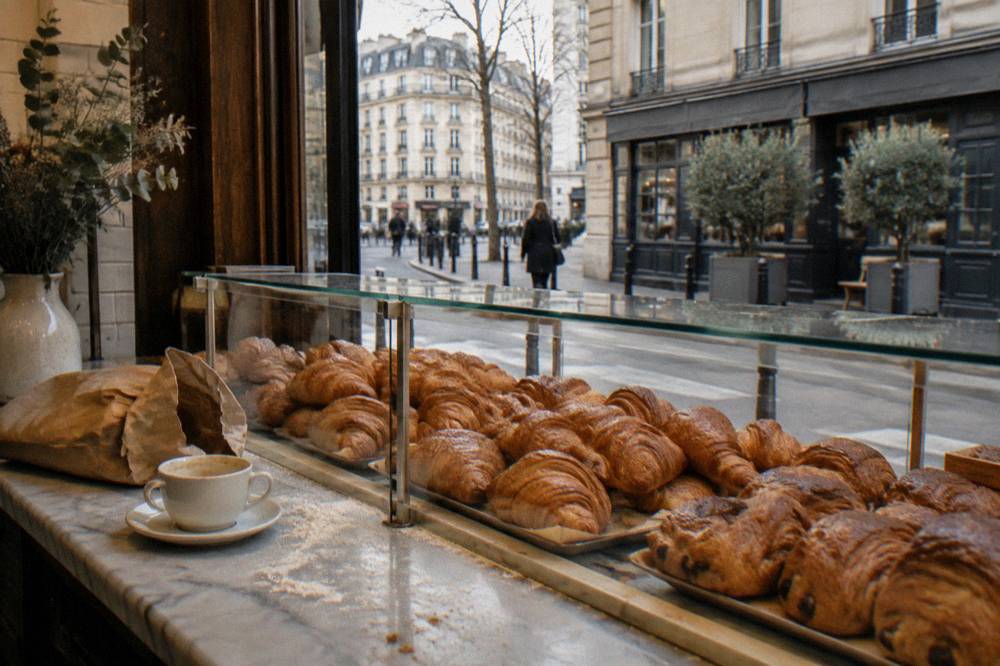
Price context keeps the bakery walk honest. A Ladurée box of six macarons lists at 21 EUR and a box of 40 at Pierre Hermé at 116 EUR, while a neighbourhood croissant costs 1.20 to 1.60 EUR. Locals spend the small number daily and the large one rarely. For visitors who want the baking side of local life rather than the eating side, the site's croissant making class guide covers the hands-on options, and the best bakeries in Paris guide maps the addresses worth a detour.
Where Do Locals Drink Wine And Eat Cheese At Night?
Locals drink at natural wine bars, where glasses typically run 5 to 12 EUR and bottles 20 to 45 EUR, and Le Verre Volé in the 10th, open daily from 12:30 to 14:30 and 19:30 to 1:00, is the reference point with more than 400 natural wine references. Cheese before or instead of dinner comes from a fromager, not a supermarket shelf.
The natural wine movement is the defining local drinking habit of the last two decades. Le Verre Volé has poured low-intervention wines since 2000, keeps over 400 references at the original bistro and more than 700 at its Oberkampf cave, and runs its wine shop at 67 rue de Lancry on separate hours, Monday to Friday 16h00 to 20h00. Glasses across the city's natural bars run 5 to 12 EUR, which makes an evening of two glasses cheaper than a single cocktail in a hotel bar.
The cheese side of the evening is its own craft culture. One fromager, Quatrehomme, has launched private cellar visits of over two hours with eight cheeses and four wines for groups capped at 12, and established cheese shops like Androuet publish serious trading hours, the Daguerre shop open Tuesday to Thursday 9:30 to 13:00 and 16:00 to 19:30. For visitors who want the pairing explained rather than improvised, the wine and cheese tours guide compares the seated tastings, and Paris Food Tours covers the full range of walks and tastings across the city.
The History Walk, Market Meal tour by Le Paris de Sophie, rated 5.0 from 73 reviews, bridges the two worlds: it starts at Pont au Change on Île de la Cité, walks the historic core, and finishes with a market lunch included in the from $217 price, in groups capped at 8.
Which Tourist Streets Do Locals Quietly Avoid?
Local-focused food guides consistently warn visitors off Rue de la Huchette and Rue de la Harpe in the Latin Quarter, and the restaurant cluster directly around Sacré-Cœur in Montmartre, describing defrosted, microwaved food aimed at one-time customers. The local rule of thumb is simple: no menu in five languages, no host inviting you in from the street.
These warnings come from guides written by food-tour operators who walk these streets daily, so they carry the bias of people selling alternatives, but the pattern is real and repeated. The Latin Quarter's Huchette strip sits on the walk between Notre-Dame and the river, catches foot traffic that will never return, and prices accordingly. In Montmartre, the blocks immediately around the basilica suffer the same economics; one neighbourhood food guide is blunt, calling the area's restaurants overpriced tourist food and pointing readers downhill toward the market streets instead.
The better Montmartre habit is breakfast: Hardware Société at 10 rue Lamarck opens Monday to Friday at 9:30 and weekends at the same hour, closing 16:00 or 16:30, and it sits in the residential upper village rather than on the souvenir route. In the Marais, the local anchor is Rue des Rosiers, where L'As du Fallafel at number 34 sells its falafel sandwich at 10 EUR, closed Saturdays, open Monday to Thursday and Sunday 11:00 to 23:30 and Friday until 15:30. The old Ashkenazi bakery Sacha Finkelsztajn, operating since 1946, stands a few doors down. The site's Le Marais food tour guide covers the neighbourhood properly, including the covered Enfants Rouges market at 39 rue de Bretagne.
How Can A Visitor Eat Like A Local Without Guessing?
The shortest route into local eating is a market-based guided walk: the Market Stroll, Picnic tour from With Love From Paris Tours takes up to 10 people through a real neighbourhood market, buys cheese, bread and wine with the group, and turns it into a picnic, from $172 per person with free cancellation up to 24 hours before the start.
The picnic format matters because it is the most local thing on the roster. Parisians shop a market and eat the results, usually on a bench or a canal-side quay, and a guided version removes the two hard parts for a visitor: knowing which stalls to trust and what to do with a raw market haul. The listing includes a libation, wine or champagne, picnic treats of cheese and bread chosen with the guide, and small surprises, with an indoor fallback when weather kills the picnic plan.
The alternative for a first visit is the seated version of the same idea. A cheese and wine tasting in a cellar, such as the Paris Art of Pairing Cheese and Wine Tasting by Paroles de Fromagers on Île Saint-Louis, rated 4.9 from 416 reviews and from $80, teaches the pairing logic a local applies without thinking. Between the two formats, a visitor covers the market habit and the evening habit, which is most of the local food day.
Common Questions About Eating Like A Local In Paris
Where Do Locals Eat In Paris?
Locals eat at morning food markets like Aligre and Raspail, at weekday formule lunches of 15 to 25 EUR between noon and 2:30pm, at neighbourhood bakeries, and at natural wine bars in the evening. The markets close on Monday, kitchens close after lunch, and almost none of it happens on the main tourist boulevards.
Are Paris markets open on Monday?
No. Every listed food market in Paris closes on Monday, per the official city schedules. Morning markets run 7h to 13h30 on weekdays and to 14h30 at weekends. Rue Montorgueil and Rue Cler, permanent shop streets rather than stall markets, stay open daily.
How much does a local pay for bread and a croissant?
The average baguette tradition in Paris costs 1.32 EUR, rising to 1.34 to 1.37 EUR in central arrondissements, and one survey of over 100 bakeries puts the average croissant at 1.22 EUR, with a typical neighbourhood range of 1.20 to 1.60 EUR.
Do you tip in Paris restaurants?
A 15% service charge is included in all displayed menu prices by law, so tipping is optional. A pourboire of 1 to 2 EUR per person is common at casual meals, and 5 EUR is considered generous on a 100 EUR mid-range dinner.
What time do locals eat dinner?
Dinner service typically starts between 19h00 and 19h30, with last orders around 22h00 to 22h30. Lunch runs from noon to about 2:30pm, after which most kitchens close until the evening service.
Is a market tour a good way to eat like a local?
It is the most direct way. Market-based walks such as the Market Stroll, Picnic tour from With Love From Paris Tours replicate the local routine of shopping a market and eating the haul, from $172 per person, with a guide choosing the stalls.