What To Eat In Paris If You Are Vegetarian
A vegetarian eating guide to Paris: which food tours welcome vegetarians, where to find falafel and market produce, what cheese and pastry cost, and how to plan a meatless food day.
What To Eat In Paris If You Are Vegetarian
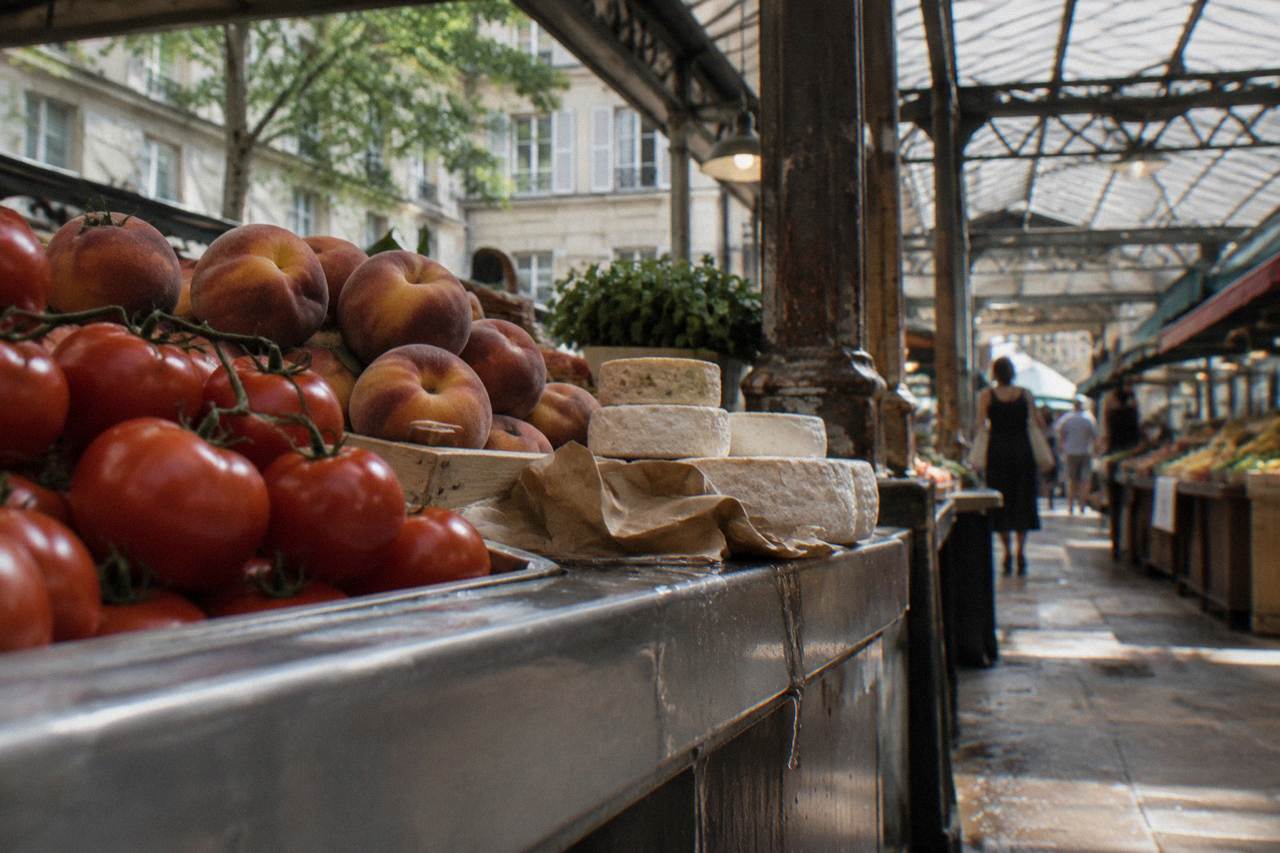
Vegetarians eat well in Paris. Cheese and bread anchor nearly every menu, the city runs 83 food markets stocked with seasonal produce, and a falafel from Rue des Rosiers runs about 10 euros. France counts 51 AOP and 12 IGP dairy products, so cheese is a meal here, not a side. Several listed tours welcome vegetarians, including the Secret Dish tour from $73 per person, though listings often exclude vegans and gluten or dairy allergies. If you're traveling with children, our guide to kid-friendly eating in Paris covers the covered markets, bakeries, and picnic spots that work for the whole family.
The short version: eat cheese, eat bread, eat pastry, and shop the markets. The long version is more interesting, because Paris rewards vegetarians who plan around the city's actual rhythm rather than hunting for a meatless version of a bistro menu. A wedge of aged Comté with a baguette from a serious boulangerie is not a compromise lunch here. It is a normal one, and often a better one than the tourist menus two streets over.
The first thing worth knowing is that the vegetarian question matters most on tours, not in restaurants. In a restaurant you can read a menu and leave. On a booked food walk, the stops are fixed in advance, so whether the operator can feed you is decided before you arrive. That is why this guide leans heavily on what the listings themselves print, and why the advice throughout is the same: confirm with the operator before you book, because each listing carries its own dietary rules. If fixed stops feel like a gamble with your diet, planning a self-guided Paris food walk puts every choice back in your hands.
The second thing worth knowing is seasonal. Paris markets sell what is in season, and the French seasonal produce calendar is the honest answer to what you will actually find on the stalls: asparagus and strawberries in spring, melon and courgette in summer, squash and figs from October, citrus and leeks in winter. Shopping that calendar is also the cheapest way to eat in the city.
For travelers who want structure rather than self-guiding, a guided walk does the planning for you, and a few options on the roster are genuinely vegetarian-friendly rather than merely tolerant.
The trio above spans the three formats that suit vegetarians best: a tasting walk whose listing welcomes vegetarians, a market picnic you assemble yourself, and a full-day cooking class where you cook the meal. The rest of this guide walks through each in the order you would actually use them on a trip.
Which Food Tours In Paris Welcome Vegetarians?
Yes, several do, and the listing text is the only source that matters. The Secret Dish tour by Secret Food Tours states that vegetarians are welcome. The Le Marais, 10 Tastings listing by Devour Tours calls itself adaptable for vegetarians and pescatarians. The Pastry and Chocolate Walk is adaptable for vegetarians but not recommended for vegans. Always confirm dietary needs with the operator before booking, because each listing prints its own limits. If the Le Marais tour catches your eye, our guide to what makes Le Marais so popular with food walkers covers the market stalls, falafel stands and pastry counters you can hunt down on your own.
The pattern across the roster is consistent: vegetarian yes in many cases, vegan and allergy cases usually no. The Secret Dish tour's listing says it plainly: vegetarians are welcome, but vegan diets and allergies to gluten, dairy and cheese cannot be accommodated. Since that tour is built around artisanal cheeses, freshly baked breads and Brittany crêpes, the exclusion makes sense. You can read the full details on the Secret Dish tour page, or Check availability if the dates matter to you.
Devour Tours is more flexible on paper. The Le Marais, 10 Tastings listing states the tour is adaptable for vegetarians, pescatarians, non-alcoholic options and pregnant women, with a note that you should advise your needs at booking. Their Pastry and Chocolate Walk goes further: adaptable for vegetarians and pescatarians, but not recommended for vegans, gluten free or nut free, which is honest, since a pastry tour without gluten or nuts is barely a pastry tour.
| Tour | Operator | From (per person) | What the listing says about vegetarians |
|---|---|---|---|
| Secret Dish, 10+ Tastings | Secret Food Tours | $73 | Vegetarians welcome; vegan, gluten, dairy and cheese allergies cannot be accommodated |
| Le Marais, 10 Tastings | Devour Tours | $107 | Adaptable for vegetarians, pescatarians and non-alcoholic options |
| Pastry and Chocolate Walk | Devour France Food Tours | $90 | Adaptable for vegetarians and pescatarians; not recommended for vegans, gluten free or nut free |
| Montmartre Full Meal Walk | Do Eat Better Experience | $102 | Vegetarian options are available |
| Bateaux Mouches Dinner Cruise | Compagnie des Bateaux Mouches | $128 | Vegetarian and vegan options available on the menus |
| 3-Course Gourmet Dinner Cruise | Extime Travel | $98 | Vegetarian options are available |
Two rows deserve a second look. The Montmartre Full Meal Walk by Do Eat Better is an itinerant full meal, so a vegetarian version means a reworked route of stops, which is why the listing says options are available rather than guaranteed. The dinner cruises are the only roster entries that print a vegan note: the Bateaux Mouches listing states vegetarian and vegan options are available on its menus, and the Extime dinner and lunch cruises both list vegetarian options. For a fuller comparison of formats, the wine and cheese tasting guide covers the seated tastings, which are vegetarian by nature since they are built on cheese and bread.
One caution applies to every row in that table: a listing note is a promise about intent, not a contract about portions. If the vegetarian version of a ten-tasting tour is six tastings, you want to know that before you pay, not at stop four. Email the operator, keep the reply, and treat it as part of the booking.
Where To Find Great Falafel And Street Food In Le Marais?
Rue des Rosiers in Le Marais is the anchor: L'As du Fallafel at number 34 sells a falafel sandwich for 10 euros, and one food guide prices the Fallafel Spécial takeaway at 8.50 euros. The shop closes Saturdays and runs Sunday through the week into the evening. Nearby, Sacha Finkelsztajn has served Ashkenazi pastries since 1946, and most Marais boutiques open Sundays from noon to 7pm.
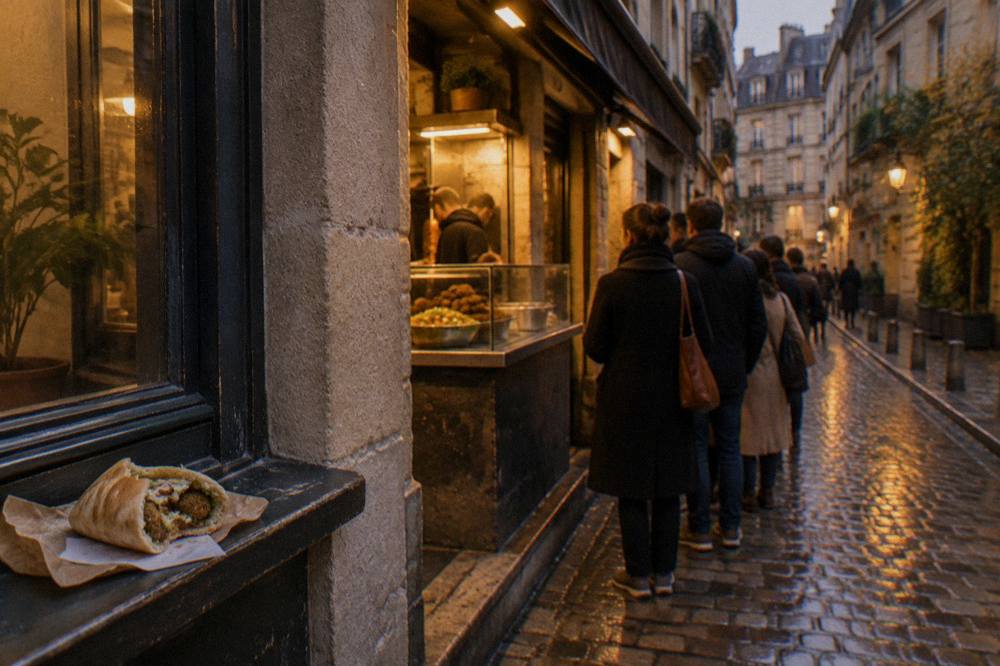
The Marais is the old Jewish quarter, and its food street delivers the closest thing Paris has to a canonical vegetarian lunch: pita stuffed with fried eggplant, hummus and pickles. L'As du Fallafel is the famous one, and the prices are modest by Paris standards. King Falafel Palace on the same street lists a pita falafel at 10 euros for takeaway, so the street gives you a fallback if the queue at number 34 stretches past the corner. Once you have finished your pita, our guide to what makes Le Marais so popular points you toward the quarter's covered market, pastry counters and small-group food walks.
The practical detail is the day. L'As du Fallafel is closed on Saturdays, open Monday to Thursday and Sunday until 23:30, and Friday only until 15:30, before the Sabbath. Get this wrong and you will be staring at a shutter. Get it right and you can pair the falafel with a Sunday, when the rest of the Marais is open too: the area is classified as a tourism zone, so most boutiques, including those on Rue des Rosiers, open Sundays, typically from noon to 7pm.
Around the corner sit two more stops worth making. Sacha Finkelsztajn at 27 Rue des Rosiers has been operating since 1946 and serves Ashkenazi pastries, the dense, filling kind that works as a walking breakfast. Florence Kahn at 24 Rue des Ecouffes draws Friday queues for fresh challah, which tells you both when to go and what locals think of it. A vegetarian could build an entire afternoon on this one street and eat nothing regrettable.
If a self-guided street crawl appeals, the broader full Paris eating guide maps the neighborhoods; if you would rather have a guide walk you into the good stops, the Le Marais, 10 Tastings tour covers this district with a listing that adapts for vegetarians.
Which Markets And Cheese Shops Feed Vegetarians Best?
Marché d'Aligre and the Marché couvert des Enfants Rouges are the two standouts. Aligre's covered Halle Beauvau runs Tuesday to Sunday; Enfants Rouges, founded in 1615, opens Tuesday to Saturday 8h30 to 20h30 and Sunday until 17h. Every listed Paris food market closes on Monday. For cheese, fromageries like Androuet and Quatrehomme surround the markets with AOP counters. To build a full eating day around stalls like these, our guide to trying a self-guided food tour in Paris explains how to time the route and how it stacks up against a guided market walk.
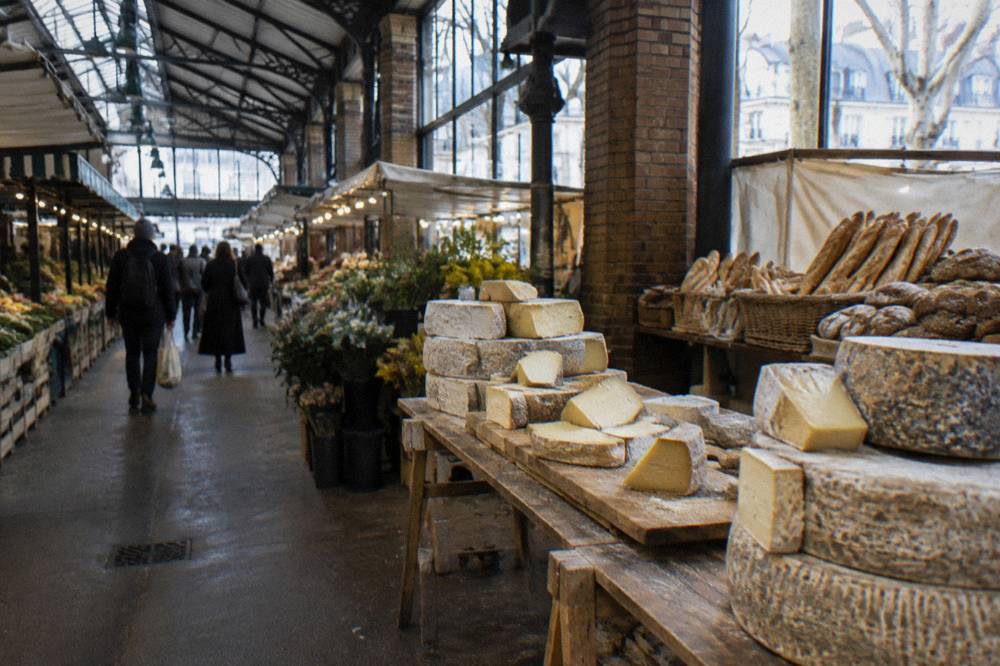
Markets are where a vegetarian traveler eats cheapest and best, and Paris runs 83 of them: 74 open-air and 9 covered, per the city's own count. The rule that catches most visitors is the Monday closure: the official market list confirms food markets are closed on Mondays citywide. Plan a market day for any other day and you are fine.
| Market | Arrondissement | Days and hours | Why vegetarians go |
|---|---|---|---|
| Marché d'Aligre (open-air) | 12e | Tue-Fri 7h30-13h30, Sat-Sun 7h30-14h30 | Cheapest produce, ethnic foods, brocante browsing |
| Halle Beauvau (covered) | 12e | Tue-Fri 8h-13h and 16h-19h30, Sat 8h-19h30, Sun 8h-13h30 | Cheese, charcuterie and produce under one roof |
| Marché des Enfants Rouges | 3e | Tue-Sat 8h30-20h30 (Thu to 21h30), Sun 8h30-17h | Oldest covered market, world cuisines, no reservations at stalls |
| Marché Raspail bio | 6e | Sun 7h-14h30 (organic); Tue and Fri 7h-13h30 traditional | One of four 100% organic markets in Paris |
| Marché Bastille | 11e | Thu 7h-13h30, Sun 7h-14h30 | Fresh produce and cheese under the Column of July |
Aligre is the one to pick if you only pick one. It has been a cosmopolitan mix of produce, brocante bric-a-brac and ethnic foods since the 18th century, and traders are known to stay open past the official hours. The Enfants Rouges is the choice for eating on site: food stalls, no reservations, busiest between 12h and 14h30, so arrive before noon if you want a seat. The Raspail organic market on Sunday morning runs around 50 certified stalls and gets busy before 11h. The rest of the planning pages sit on Paris Food Tours.
Cheese shopping around the markets is its own discipline. Androuet runs several fromageries, including the Daguerre shop open Tuesday to Sunday with a midday break, and the Verneuil shop closed Sundays. Quatrehomme on Rue de Sèvres and its Martyrs branch in the 9e carry the same AOP counters, and Fromagerie Nicole Barthélémy on Rue de Grenelle closes Sunday and Monday. Hours shift; the phone numbers are on the operators' pages.
None of this changes what is in the case today, but it explains why cheesemongers talk about grass and feed the way sommeliers talk about soil. If you want the cheese without the shopping, seated tastings do it well: the Pairing in a Cheese Cellar session by Paroles de Fromagers runs from $80 per person with 7 cheeses and 3 wines, and the Montmartre Cheesemonger Tasting by EATCHEESEWITHMAX runs from $77 with 8 cheeses and 5 wines. Both are vegetarian meals in all but name.
If assembling your own picnic sounds better than being led, one roster listing does exactly that.
The Market Stroll, Picnic tour by With Love From Paris Tours includes the guide's selection of picnic treats from a local market, cheese and bread among them, plus a glass of wine or champagne, and runs from $172 per person in groups of up to 10. The meeting point is sent on booking, and the listing notes that snacks replace the picnic when weather makes one impossible. Tell the operator you are vegetarian when you book and the selection follows.
What Do Vegetarians Order In French Restaurants?
Order the formule: two courses at decent bistros run 15 to 25 euros at lunch, and a 15 percent service charge is already included in every displayed menu price by law. Ask for a carafe d'eau and tap water must be brought free. State vegetarian needs when reserving, since kitchens plan around them, and check the menu displayed outside before sitting down.
Restaurant strategy for vegetarians is about timing and law, in that order. Lunch service typically runs noon to 2:30pm with kitchens closing afterward, and dinner starts between 7:00 and 7:30pm. The formule déjeuner, a fixed two-course lunch, is the best-value vegetarian entry point in the city, because the plat du jour is often a vegetable-forward dish anyway. By law, menus and plats du jour must be displayed outside from at least 11:30 for lunch and 18:00 for dinner, so you can audit a restaurant's vegetarian range before committing to a table.
The law is quietly on your side in two more ways. Service is included: a mandatory 15 percent service charge is baked into displayed prices, so tipping is optional, with a euro or two per person for rounding up the norm at casual meals. And restaurants must provide free potable tap water on request to customers eating on site; ask for a carafe d'eau and it arrives without a bill line. Bread may be charged only if its price is visibly displayed on the menu beforehand.
The classic vegetarian traps are the tourist streets. Avoid Rue de la Huchette and Rue de la Harpe in the Latin Quarter for meals, where the consensus among local food writers is microwaved tourist food, and skip the restaurants clustered right at Sacré-Cœur in Montmartre for the same reason. Walk three streets in any direction and the menus improve and the prices drop.
Reservations matter more than vegetarians expect. They are strongly recommended even at casual bistros, especially on Fridays and Saturdays, and allergies and dietary restrictions should be mentioned at the time of reservation so the kitchen can plan. A French kitchen told in advance that you are vegetarian will often produce something off-menu; a kitchen told at the table will produce the sides.
For the days when a restaurant feels like too much planning, the budget food guide to Paris collects the cheap standbys, markets included.
Which Cooking And Baking Classes Work For Vegetarians?
Cooking classes are the safest vegetarian bet in Paris because you cook the meal yourself. Le Foodist's Full-Day Class and Lunch runs 6 hours from $246 per person and includes a market tour plus a 4-course meal with wines. Macaron and croissant classes from $103 to $134 are naturally meatless. Confirm dietary needs with the operator first, and note the full-day class does not admit children under 12.
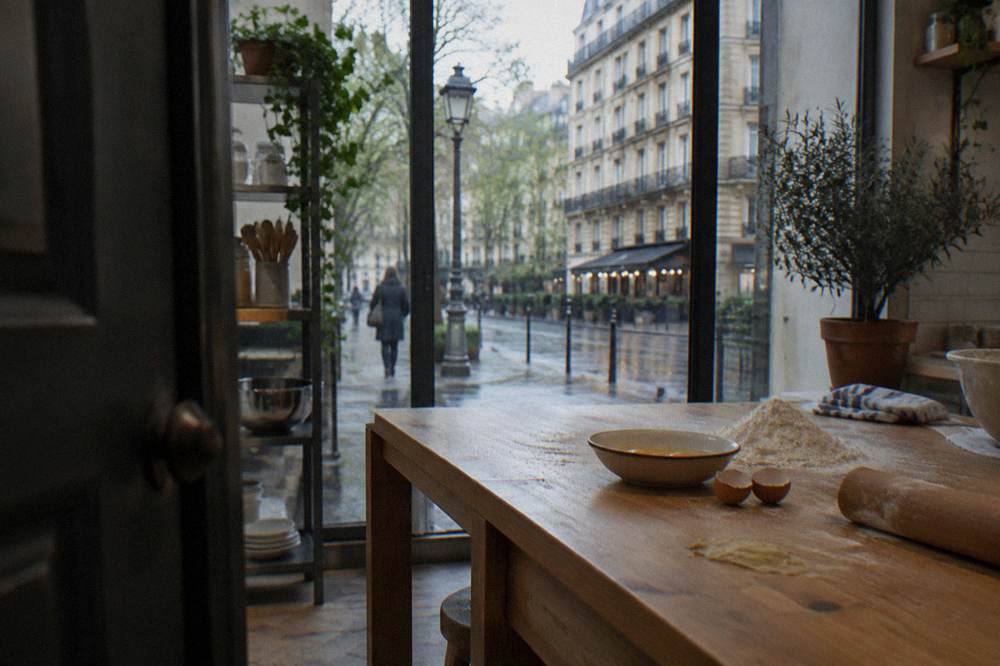
A class inverts the dietary problem. On a walking tour, the stops are fixed and you adapt; in a class, the menu adapts to the room, and a vegetarian participant changes what gets cooked rather than what gets skipped. Le Foodist teaches its classes in English, with or without a market visit, followed by a three-course meal with wines, and its full-day format combines a market tour, the class and a 4-course lunch with cheeses and red and white wines, limited to 12 participants, with recipes to take home in hard copy and electronic form.
The baking classes are the simplest case of all, because French pastry is vegetarian by default. The Macaron Class by Ateliers Parisiens runs 2.5 hours from $112 with a chef instructor and a box of macarons to carry away. Studio Pâtisserie runs both a Croissant Baking Class from $134, limited to 8, and a Central Paris Macaron Baking class from $117, limited to 10. ExperienceFirst runs a Bread, Croissant or Macaron class from $103 in the Haut-Marais, limited to 8, where kids under 5 can join free of charge but cannot fully participate, per the listing.
The Full-Day Class and Lunch by Le Foodist is the deepest version: 6 hours from $246 per person, starting in the Latin Quarter, market shopping in the morning and a four-course meal you cooked at the end of it. Two fine-print items from the listing: children under 12 are not permitted, and the operator's own evening class has a different cancellation window, so read the terms for whichever session you book rather than assuming the standard 24-hour cutoff the rest of the roster prints.
One honest limitation: none of these classes is a vegan class unless the operator says so. Ask, in writing, at booking. The answer is usually yes for vegetarian, sometimes no for vegan, and the pastry classes cannot remove gluten or nuts at all.
How To Build A Vegetarian Food Day Around The Seasons?
Build the day around what is in season: asparagus and strawberries in spring, melon and courgette in summer, squash and figs from October, citrus and leeks in winter. A market breakfast, a fromagerie lunch and an afternoon pastry cost little: the average baguette tradition runs 1.32 euros and a croissant about 1.20 to 1.60. Seasonal produce is the cheapest food in the city.
Here is a template day, priced from verified figures only. Morning: a market, any non-Monday market, for fruit and whatever the season offers, plus a baguette tradition, averaging 1.32 euros in Paris and a touch more in the central arrondissements. Midday: a fromagerie for cheese, or the formule at a bistro at 15 to 25 euros for two courses. Afternoon: pastry, where the benchmarks are a croissant at 1.20 to 1.60 euros at a neighborhood boulangerie, an individual macaron at Angelina from 3.20 euros, and a box of six macarons at Ladurée at 21 euros.
| Season | What is at its peak | What to do with it |
|---|---|---|
| Spring | Peas, asparagus, artichoke, rhubarb, strawberry | Market asparagus with a soft cheese, strawberry tart |
| Summer | Melon, raspberry, courgette, aubergine, pepper | Picnic day: melon, raspberries, bread, cheese |
| Autumn | Squash from October, apples, pears, figs, plums | Roast squash at a class, figs with fresh cheese |
| Winter | Citrus from December, leeks, endive, parsnip | Endive salad, citrus over fromage blanc, hot bistro lunches |
| Vegetarian benchmark | Typical price | Notes |
|---|---|---|
| Falafel sandwich, Rue des Rosiers | 10 euros | Fallafel Spécial takeaway listed at 8.50 euros by one guide |
| Baguette tradition | 1.32 euros average | 1.34 to 1.37 in the 3e, 6e, 7e, 8e, 16e |
| Croissant at a neighborhood boulangerie | 1.20 to 1.60 euros | One survey of over 100 addresses puts the average at 1.22 euros |
| Individual macaron at Angelina | from 3.20 euros | Coffret of 4 from 12 euros |
| Box of 6 macarons at Ladurée | 21 euros | Box of 12 at 39 euros |
| Formule déjeuner, two courses | 15 to 25 euros | Includes the 15 percent service charge by law |
The seasonal table is not decoration; it is a budget tool. Out-of-season produce in Paris is imported, priced accordingly and often bland, while the October squash and December citrus arrive at their best and cheapest. A vegetarian eating with the calendar spends less than one fighting it, and the markets make the calendar visible: the stalls themselves tell you what to cook this week.
Pair the day with a drink and the picture completes. France counts 51 AOP and 12 IGP dairy products, per INAO's dairy figures, and a cheese-and-wiring afternoon is the most Parisian vegetarian meal there is. If you want that arranged rather than improvised, the seated wine and cheese tastings on the roster start from $77 per person.
If all of this sounds like a lot of logistics for one trip, that is the honest conclusion: vegetarian Paris rewards planners. The reward is that the planning itself, the markets and the fromageries and the pastry counters, turns out to be the part worth doing.
Common Questions About Vegetarian Eating In Paris
What To Eat In Paris If You Are Vegetarian?
Cheese, market produce, falafel from Rue des Rosiers, and pastry. France counts 51 AOP and 12 IGP dairy products, so a fromagerie lunch is a full meal, and the average baguette at 1.32 euros completes it. Add a market for seasonal fruit and a bistro formule at 15 to 25 euros for two courses at lunch, and a vegetarian eats very well.
Can Vegans Join Paris Food Tours?
Rarely, on the evidence of the listings. The Secret Dish tour states that vegan diets cannot be accommodated, and the Pastry and Chocolate Walk is not recommended for vegans. The one clear exception on the roster is the Bateaux Mouches Dinner Cruise, whose listing states vegetarian and vegan options are available on its menus. Confirm with the operator before booking in every case.
Do Paris Cooking Classes Cater To Vegetarians?
More readily than walking tours, because the menu adapts to the room. Le Foodist teaches in English and builds classes around a three-course meal with wines, and its full-day format adds a market tour and a 4-course lunch from $246 per person. Baking classes, from $103 for a bread, croissant or macaron class, are meatless by nature. State your diet at booking.
How Much Does A Vegetarian Day Of Eating In Paris Cost?
Less than most visitors fear. A croissant runs 1.20 to 1.60 euros, a baguette tradition averages 1.32, a falafel on Rue des Rosiers is 10 euros, and a two-course lunch formule at a decent bistro runs 15 to 25 euros with the 15 percent service charge already included. A guided option such as the Secret Dish tour starts from $73 per person.
Are Paris Food Markets Open Every Day?
No. Food markets are closed on Mondays citywide, per the official market list. Morning markets open 7h to 13h30 on weekdays and until 14h30 at weekends. Marché d'Aligre and the covered Enfants Rouges run Tuesday to Sunday with their own printed hours, and the Raspail organic market runs Sunday mornings from 7h to 14h30.